
IMPERIAL ARSENAL — MELEE WEAPONS
Blade Works
The sacrament of the edge — chainswords, combat knives, and eviscerators of the God-Emperor's servants, wielded in the breach where no gun may save.
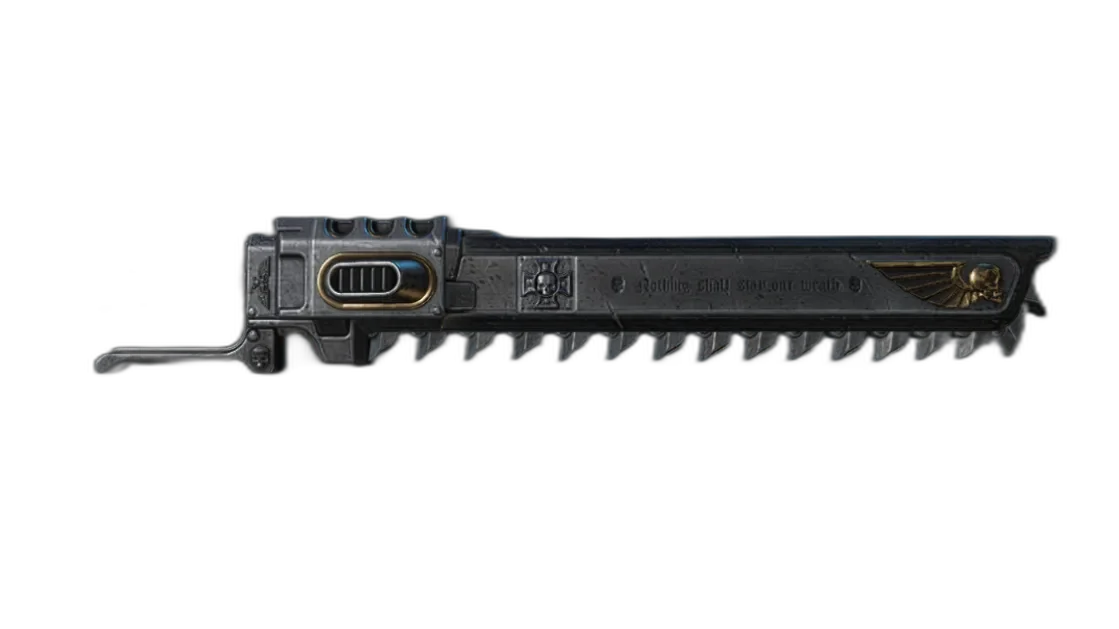
Tap a zone on the blade to explore
Melee Weapons — All Sections
When Steel Meets Flesh
In the 41st Millennium, where bolt rounds can pierce battle-plate at a hundred metres and plasma coils can reduce a tank to vapour, the killing blow delivered at arm's length remains an article of faith across every branch of the Emperor's military. The doctrine of close combat is not a concession to technological failure — it is an affirmation that the warrior's own body, the extension of his arm, the edge or the spinning teeth of a blade pressed against the enemy's flesh, constitutes the most intimate expression of the Emperor's will made manifest. To close with the enemy and destroy him is to honour ten thousand years of Imperial doctrine stretching back to the very first wars of Unification, when humanity's survival was measured not in strategic objectives but in the reach of a soldier's arm. Among the close-combat arms of the Imperium, non-powered weapons of chain and steel occupy a particular place of honour — not in spite of their simplicity, but because of it. A chainsword carries no machine spirit that requires constant appeasement, no temperamental energy coil that might fail at the moment of supreme need. Its machine spirit, such as it is, is crude and reliable: a motor, a chain, and the will of the warrior holding it. The Adeptus Mechanicus teaches that these weapons embody a different kind of sacred covenant than their power-field counterparts — the covenant of uncomplicated, dependable lethality that has served the Imperium without interruption since the dark centuries before the Great Crusade. Where the power sword demands skill and reverence, the chainsword demands only will and strength. The psychological weight of the close kill should not be underestimated by any student of Imperial warfare. It is one thing to pull a trigger at range, to watch an enemy crumple at a distance that grants the shooter a comfortable remove from the act of destruction. It is another matter entirely to drive a blade into a man, to feel the resistance and the giving, to finish the deed with a second stroke when the first has not sufficed. Imperial doctrine does not shy from this reality — it codifies it. The Departmento Munitorum's combat manuals for the Astra Militarum devote extensive chapters to the mental fortitude required of close-combat specialists, acknowledging that the capacity to kill at hand-length is a discipline of the soul as much as the body. Those who cannot sustain that discipline are not suited for the blade, however brave they may be at range. Culturally, the blade and its kin carry a weight of inherited significance that no ranged weapon can match. Oaths in the Astra Militarum are sworn on bayonets fixed to lasguns; in some regiments a soldier's first combat knife is sealed to him at induction, to be carried until death and buried with him unless it passes to a worthy successor. Among the Adeptus Astartes, relic blades carry the deeds of every warrior who wielded them, their history inscribed in the chapter's annals and whispered over in the armorium. The act of naming a blade — and blades are named, from the grand relics of Chapters to the field-ground Catachan Fang that has no name but the one its owner gives it — transforms an instrument of iron into an inheritance. To receive a named blade is to receive a charge; to carry it is to carry the expectation of all those who carried it before. The breadth of warriors who fight with non-powered melee weapons spans the full range of the Imperium's military hierarchy. At the lowest tier, Astra Militarum infantry fix bayonets and advance with combat knives at their belt, trusting in massed courage where individual skill may be lacking. Veterans and specialists — Catachan warriors, Stormtrooper close-assault teams — carry blades honed to surgical edges and train in forms that make them dangerous even against physically superior foes. Further up the hierarchy, Adepta Sororitas Repentia carry great eviscerators into battle as instruments of penitential fury, the shrieking teeth of their chain-weapons an act of worship as much as destruction. Adeptus Astartes carry chainswords as standard sidearms, the weapon's rapid-cycling teeth capable of sawing through the armour of even post-human opponents. Inquisitorial acolytes keep blades as last-resort tools and tools of interrogation alike. The distinction between non-powered and power-field melee weapons deserves explicit statement, for readers unfamiliar with the Imperium's arsenal may conflate the two categories. Where a power sword or thunder hammer generates a disruptive energy field that sunders molecular bonds at contact — capable of cutting ceramite armour as if it were parchment — the chainsword, the combat knife, and the eviscerator rely on physical mechanisms: rotating chains of hardened teeth, sharpened monoblade edges, blunt force concentrated in mass and momentum. This is not inferiority. The power sword requires an active power source that can fail, a field generator that skilled opponents learn to target; the chainsword's motor runs on a power cell that provides thousands of cycles before exhaustion and can be field-replaced in minutes. The grinding, tearing sound of a chainsword at work — the shriek of spinning adamantine teeth against ceramite, the wet report of the same teeth through flesh — carries its own terror distinct from the crackling hiss of a power blade. The Imperial soldier who understands both categories understands that they are not substitutes for one another; they are complements, filling different roles in the close-assault doctrine that has won more victories for the Emperor than any other tactical principle in ten millennia of war.From Unification to the 41st Millennium
The lineage of chain-weapons stretches back to the pre-Imperial era on Terra, where early fragments of Standard Template Construct data record industrial cutting tools built on the same fundamental principle — a driven chain of hardened teeth, rotating continuously over a guide bar — that were used to clear the immense forests of Old Earth and to process the hulls of derelict voidships in the orbital graveyards above humanity's birth world. The bayonet is older still, a weapon philosophy that predates even these relics: the concept of mounting a blade upon a long-range weapon to extend its utility into close combat is so primordial that it appears independently across a dozen pre-Unification cultures on Terra and on every colony world that was settled before the Age of Strife sundered the human sphere. When the first soldiers fixed knives to the ends of their firearms, they were codifying an instinct as old as warfare itself — that no weapon should ever be truly empty, and that the final distance between enemies is always covered on foot with steel in hand. The wars of Unification that consumed Terra across the centuries before the Emperor's ascent were formative for melee weapons doctrine in ways that shaped Imperial thinking for ten thousand years to follow. The Emperor's own forces on Terra fought in environments where firearms often failed — the toxic underhives of the western continents, the perpetually jammed corridors of fortress-complexes where las-discharge would ricochet as lethally as enemy fire — and in these environments the chainsword and the combat knife were frequently decisive. The warlords the Emperor faced and overthrew were often heavily armoured in crude but effective power plate, and the chainsword's grinding teeth could bite into that plate where bolt rounds were deflected. Veterans of the Unification Wars who survived to see the Great Crusade would later testify that the Emperor's warriors had carried the same chain-blade patterns from the first battles of Terra to the last compliance actions at the galaxy's edge. When the Great Crusade set forth into the void, the chainsword had already been standardised as the primary close-combat sidearm of the Space Marine Legions — a designation it would hold throughout the crusade's long progress. The Adeptus Mechanicus forge-worlds that supplied the Legions manufactured chainswords in prodigious numbers, the weapon's relative simplicity allowing mass production that more complex armaments could not match. For the nascent Imperial Army — the precursor to what would become the Astra Militarum — bayonets and combat knives were issued as universal equipment across every regiment, the Departmento Munitorum's logistical manuals of the era specifying that no soldier should ever be without a close-combat option regardless of his primary weapon's ammunition state. The Salamanders of the XVIII Legion developed particular expertise in close-quarters blade combat alongside their renowned flame and thermal doctrine, their Firedrakes setting standards for chainsword technique that were studied across the Legions. The Horus Heresy exposed every weakness and every virtue of these weapons with merciless clarity. When treachery turned brother against brother at arm's length, the chainsword's primordial simplicity was suddenly the most valuable quality it possessed — unlike more complex weapons, it could not be disabled by disruption fields, sabotaged power supplies, or electronic warfare. World Eaters warriors in the grip of the Butcher's Nails fell upon loyalists with chain axes and drove the fighting to such close quarters that ranged weapons on both sides became useless, battles degenerating into prolonged brutal melees decided by physical endurance and sheer savagery. During the Siege of Terra itself, some of the most consequential close combats of the entire war were fought at blade-length in the tunnels and corridors below the Imperial Palace's outer fortifications, where Blood Angels and the Emperor's Custodian Guard held passageways against overwhelming traitor numbers using nothing but their blades and their will. The chainsword, which had begun the Heresy as an auxiliary weapon, ended it as the final arbiter of which side held the line. The long centuries between the Heresy's conclusion and the 41st Millennium saw the weapons codified into increasingly rigid doctrinal frameworks, a process driven in equal measure by the conservative instincts of the Adeptus Mechanicus and the trauma-driven nostalgia of the Adeptus Astartes for weapons that had served in the founding wars. The Ecclesiarchy's rise to institutional power in the 36th Millennium introduced a new dimension to melee weapon culture: the eviscerator, a double-handed chain-weapon of enormous size and weight, became closely associated with the Ministorum's more extreme expressions of faith. The Redemptionist cults that flourished in the underhives of a hundred Imperial worlds adopted the eviscerator as a weapon of religious significance, its roaring chain a constant auditory reminder of the righteous wrath that awaited the unbeliever. Regional variations proliferated in this period — the Catachan Fang, the long-bladed combat knife of the Death World regiments, developed such a strong cultural identity that it became more than a weapon: a Catachan warrior's knife was a part of his identity, and to lose it in battle was a matter of personal shame that could only be resolved by recovering it or taking a finer blade from an enemy worth killing. The close of M41 finds non-powered melee weapons as prevalent in the Imperium's arsenal as they were at the crusade's dawn, perhaps more so. The endless wars of the Era Indomitus have consumed logistics chains and stripped ammunition reserves to the bone across dozens of warzones, and in these conditions the chainsword and the knife reveal their most fundamental advantage: they do not run dry. A warrior whose lasgun cell is spent and whose bolt rounds are exhausted still has his blade, and that blade has ended as many battles in the forty-first millennium as any plasma charge or melta burst. The Ultramarines and their successors who fought the length of the Indomitus Crusade recorded engagement statistics showing that a striking percentage of decisive close assaults were concluded at arm's length with chain or cutting weapons — testament that no advance in ranged technology has yet rendered the killing blow at hand's reach obsolete, and that in all likelihood none ever will.Chainswords and Chainaxes
The mechanical principle of chain-weapons is ancient and elegant in its simplicity: a motor housed in the hilt drives a continuous loop of adamantium-tipped teeth along a guide track cut into the blade's spine, completing hundreds of cycles per second. When the weapon bites into armour or flesh, the teeth do not merely cut — they tear, abrade, and drag material inward along the chain, the kinetic energy of the rotating mechanism amplifying each stroke beyond what muscle alone could achieve. The distinctive sound is inseparable from the weapon itself: first the rising whine of the motor as the trigger is depressed, then the shriek that follows when those spinning teeth engage resistance. Warriors who have stood opposite a charging enemy with chainswords raised describe the noise as arriving before the enemy does, a wall of mechanical scream that carries the promise of what is coming. The Adeptus Mechanicus records this sound signature as a recognized Machine Spirit expression — the crude, uncomplicated hunger of a blade that knows exactly what it was made to do. Among Adeptus Astartes armouries, the chainsword occupies the role of standard close-combat sidearm — the weapon a Space Marine reaches for when bolt rounds are spent and the enemy is still standing. The basic Astartes chainsword pattern weighs roughly three kilograms, balanced to complement power-armoured strength, with a blade length of approximately eighty centimetres and a tooth-chain capable of cycling through ceramite plate given sufficient pressure and time. Yet the breadth of Chapter-specific variants that have evolved from this baseline reveals how deeply the chainsword has been absorbed into Space Marine culture. The Blood Angels favour ornate hilts chased in gold and black, their blades often named and inscribed with the deeds of previous bearers. Chapters of the Adeptus Astartes in the Fenrisian tradition carve runes into the cross-guard. In virtually every Chapter, oath scrolls hang from the pommel at formal occasions, the parchment bearing the warrior's battle-vows and sealed with Chapter wax — a practice that transforms an instrument of destruction into a covenant made manifest in iron and adamantium. The chainaxe occupies a related but distinct tactical niche, its heavier geometry favouring the cleaving blow over the thrust. Where a chainsword's narrower profile rewards speed and precision, the chainaxe's broad head delivers mass to the strike, capable of shearing through limbs and rending armour through sheer momentum rather than tooth-cycling alone. Among the Chapters of the Adeptus Astartes, the Space Wolves maintain a particular cultural affinity for the chainaxe — the weapon suits their aggressive close-in fighting style and echoes the axes of the Fenrisian warriors from whom the Chapter draws its recruits. The Space Wolves' Rout-era tradition of naming axes and reading battle-history from the notches in a blade's edge persists in the modern Chapter, where a veteran's chainaxe may carry decades of campaign history in its scars. Other Chapters whose martial culture prizes the overhead cleaving blow over the fencer's form have adopted the chainaxe for similar reasons, valuing its capacity to end a fight in a single committed stroke. Among the traitors, the former World Eaters of the Long War drove their chainaxes into the bones of the Horus Heresy's worst massacres; their berserker descendants carry those weapons still, though this dishonour belongs to the fallen and not to the pattern itself. The Astra Militarum fields chainswords as the close-combat weapons of officers, commissars, and specialists across its thousands of regiments. An Astra Militarum commissar's chainsword is a tool of leadership as much as violence — when discipline requires it to be drawn before the enemy is even engaged, its sound alone is sometimes sufficient to resolve the question of whether a wavering squad will hold its ground. Standard-issue Guard chainswords are simpler in manufacture than Astartes equivalents, their tooth-chains replaced more frequently and their motors tuned for less strenuous use, but the fundamental weapon is identical in principle. Ogryn Auxilia are sometimes issued modified chainblades scaled to their larger frames — broader-toothed, heavier, and capable of dismembering opponents that a standard chainsword would merely wound. The Adepta Sororitas field chainswords among their Battle Sisters and Veterans, where the weapon's volume in combat reinforces the auditory theatre of Sororitas assault — bolter fire, plasma, flamers, and the screaming of chain-teeth all together. The psychological dimension of chain-weapons in close combat cannot be separated from their physical utility. The sound arrives before the warrior; it has already declared itself before the blade connects. Experienced soldiers report that the scream of an enemy chainsword in darkness — when the weapon cannot yet be seen — is among the most corrosive sounds a combatant can endure, carrying within it the knowledge that a motor-driven blade is searching for flesh in the same enclosed space. The Astra Militarum's combat psychology doctrines acknowledge this effect explicitly, instructing commissars and training cadres to use the weapon's sound as a morale force distinct from its physical threat. In urban assaults and tunnel warfare especially, where range counts for little and the enemy may be seconds away from contact, the roar of a chainsword is understood by those who have fought up close as a weapon unto itself — the opening declaration of a fight that will be settled at arm's length. Chain-weapons demand a maintenance discipline that their reputation for crude simplicity might not suggest. The tooth-chain wears with use and must be replaced after sustained combat; the motor seals require regular lubrication against dust, blood, and moisture that each engagement deposits in the mechanism; the guide track can warp under heat and must be checked against gauge after every significant action. Adeptus Mechanicus armourers who maintain Space Marine weapons recite binharic prayers over chainswords before battle, anointing the chain with sacred oils and listening to the motor's sound for aberrations that indicate wear. In the field, Astartes battle-brothers carry spare tooth segments and the simple tools needed to replace them; a chainsword rebuilt under fire from its own components is a recurring feature of campaign records across ten thousand years of Imperial warfare. The weapon's willingness to accept field repair — to be broken down to components and reassembled by hands still wet with the blood of the last engagement — is perhaps its most fundamental virtue. A chainsword that has been rebuilt three times in a single campaign carries more history in its frame than many relics, and in some Chapters that history is recorded. The eviscerator stands apart from the standard chainsword as an oversized chain-weapon of exceptional lethality, its double-handed frame and broader tooth-chain demanding strength beyond unaugmented human limits to wield with control. Its roaring chain is synonymous with the Adepta Sororitas Repentia's penitential fury and with Redemptionist cult violence across the underhives of a hundred worlds. The weapon's history and particular cultural weight are addressed in its own section below.Training and Duty
The first weapon every Adeptus Astartes Neophyte learns to use is not a bolter. It is a length of hardwood, or a blunted training blade, wielded in the sparring pits beneath the Fortress-Monastery while a Chaplain walks the edge of the pit and names every opening, every error, and every failure with equal dispassion. The purpose is not primarily to develop a winning technique with the blade — it is to install reflexes that will function after the body has been broken and rebuilt, after the Black Carapace has been implanted and the armour has been bonded to the nervous system, after the warrior has seen a decade of war and learned to move through the wreckage of others without hesitation. The combat instincts hammered into the Neophyte in those early years will be the bedrock on which everything else is built. A Space Marine who has lost his bolter, whose power fist is shattered, whose armour is buckled — that warrior still has what the sparring pits gave him, and in the history of the Imperium, that has been enough to change the outcome of battles beyond counting. The Astra Militarum approaches blade training from a different angle, less concerned with the individual warrior's martial excellence than with the morale and psychological effects of the charge. Bayonet drill is basic doctrine for virtually every Imperial Guard regiment regardless of homeworld or specialty — the extension of the lasgun into a stabbing weapon bridges the gap between the shooting line and the enemy body, and the act of fixing bayonets before an advance is as much a signal to the regiment itself as it is a preparation for killing. The sound of ten thousand bayonets clicking into place has broken enemy resolve before a single man has moved. Knife discipline — the maintenance, concealment, and emergency use of the combat blade — is taught alongside bayonet drill, the shorter weapon for the situations that the fixed bayonet cannot address. Officers and veterans carry dress blades that double as functional weapons, and the tradition of the close kill with cold steel is kept alive as a point of professional pride even in an era when a man might reasonably expect to fight his entire career at ranges where the blade never leaves its scabbard. The martial culture of the Ecclesia runs deeper than mere weapon proficiency. Sisters of the Adepta Sororitas are trained in the scourge and the Eviscerator alongside the bolter and the flamer, the blade disciplines woven into devotional practice so thoroughly that the distinction between drill and prayer becomes academic. Morning rites in many convents include weapon-handling forms performed in unison — the controlled swings, the guard positions, the economy of movement that will serve in the melee that faith demands its servants enter. Redemptionist preachers punctuate their sermons with blade ritual: the uncovering of the weapon, the passage of it before the congregation, the re-sheathing as a punctuation mark in the homily. For such warriors, training is not separate from worship. The blade is a sacrament, and drilling with it is a form of prayer addressed to the Emperor through the body rather than the voice. Sparring and formal duel culture are present throughout the Imperium, from the duelling circles of officer messes to the sanctioned pit-fights of Astartes Fortress-Monasteries. Officers of the Imperial Guard settle points of honour with dress blades under prescribed forms — seconds, witnesses, the rules of first blood versus fight to incapacity — a tradition with roots deep in Terra's pre-Unification aristocratic cultures. Among the Adeptus Astartes, the sparring pit under the Chaplain's eye is where oath-blades are sworn upon and later wielded: the weapon used in a formal contest between battle-brothers is invested with the memory of that contest, and to carry it into battle is to carry that history. The Blood Angels keep elaborate records of sparring victories and setbacks among their Neophytes, believing that the patterns of a warrior's melee style reveal character flaws that the Chapter's spiritual guides must address before those flaws manifest under fire. Maintenance is devotional practice. No warrior in the Imperium's major fighting traditions treats the cleaning and sharpening of a blade as a purely mechanical task. A chainsword's chain track is inspected link by link, each tooth examined for chips or scoring, the motor housing opened and the lubricant replaced to a specific consistency specified in texts that the Adeptus Mechanicus regards as liturgical documents. A simple combat knife is oiled with rendered animal fat or sacred unguent and wrapped in clean cloth between uses, the metal treated as a living thing that must be kept in condition to serve. Heirloom blades passed down through regiments over generations — carried by a score of hands before the current bearer received them — are maintained with a reverence that approaches the care given to chapter relics. The weapon's machine spirit must be honoured, and those who neglect their blades find that the Adeptus Mechanicus and the Chaplains are in rare agreement: a warrior who cannot be trusted to maintain his weapons cannot be trusted in the line. There is, finally, a question that every military doctrine in the Imperium must eventually answer: why insist on close-quarters blade discipline in an age of macrocannons, orbital bombardment, and weapons that can glass a continent? The answer given by every tradition that has survived long enough to develop one is always the same. The blade teaches what the lasgun does not. It teaches that the enemy is a physical reality, a body that must be reached, that cannot be destroyed at comfortable range from behind cover, that must be confronted as a fact of the world rather than a target in a sight picture. The warrior who has stood in the melee, who has learned to read an opponent's weight distribution and intent in the quarter-second before a blow lands, who has felt the resistance of flesh and the finality of a killing stroke — that warrior understands war in a way that no amount of marksmanship training can replicate. The Imperium fights wars that last centuries on worlds where electronics fail and ammunition runs out and the only thing standing between a position and its loss is the willingness to close, to hold, and to kill by hand. It produces warriors who are ready for that moment, because every hour in the sparring pit is preparation for it.Combat Knives and Bayonets
The Astra Militarum combat knife is issued to every soldier upon induction, alongside the lasgun and the aquila-stamped identity tags that mark a man as property of the Departmento Munitorum from the moment of his enlistment until the moment of his death. It is at once utility tool and killing blade — used in a single campaign to cut ration packs, strip wire, mark trail signs, dig firing positions, and open the throats of sentries without raising a sound. The standard pattern is a double-edged blade of approximately thirty centimetres, the spine thick enough to pry with and the edge maintained at a sharpness the Munitorum manuals specify with unusual precision: a blade that cannot shave the hairs from a soldier's forearm is a blade that will not pass inspection. That this weapon is listed alongside ration supply, entrenching tool, and flak vest — as mundane as canteen and boot — should not obscure the fact that more Astra Militarum soldiers have killed at close range with a combat knife than with any other weapon in the regiment's inventory except the lasgun itself. The bayonet represents the philosophical marriage of ranged weapon and blade, and in the Astra Militarum the practice of fixing bayonets to lasguns is one of the oldest sustained tactical doctrines in the Imperium's military history. From the great infantry assaults on Cadia's Kasrkin training grounds to the grinding trench advances of Armageddon, the bayonet charge is understood as the moment when a regiment commits itself completely — when it abandons the relative safety of range and declares, by the physical act of clicking steel to muzzle, that it will close with the enemy and destroy him or die in the attempt. Regimental commanders who order the bayonet fixed do so understanding that the psychological effect on both sides is immediate: the assault becomes committed, the defenders know that their opponents have accepted personal risk in a way that sustained ranged fire does not demand. Departmento Munitorum doctrine assigns the bayonet charge its own chapter in assault manuals, with specific guidance on formation, timing, the moment of contact, and the discipline required to maintain momentum when the first rank strikes home and the second must charge through. Among the Adeptus Astartes, the combat knife is a sidearm carried in addition to the chainsword and bolt pistol, occupying the role of last-resort tool when all other weapons are spent or inaccessible. Astartes combat knives are typically monomolecular-edged — their blades ground to a single molecule's width along the cutting edge, capable of sliding between ceramite plate joins that a conventionally-sharp blade could not penetrate. A veteran Space Marine's knife is both weapon and ritual instrument: used to cut the oath scrolls that are bound to weapons before battle, to mark a Chapter's symbol into the armour of the fallen as a record of their identity, to finish wounded enemies after a breach-assault when efficiency demands it. In some Chapters, combat knives pass from veteran to novice as the veteran advances in rank, the knife carrying the weight of everything its previous bearer accomplished. The Ultramarines maintain a tradition of inscribing a knife's blade with a single word — a virtue the Chapter expects the bearer to embody — that remains with the knife through every subsequent bearer, accumulating a genealogy of expectations in the steel. The regional and regimental variation in combat knife pattern is extraordinary even by the Imperium's eclectic standards. The Catachan Fang — the broad-bladed, heavy-tipped jungle knife of Catachan Death World regiments — is as much cultural emblem as weapon: a Catachan warrior's knife is made on-world, sometimes by the warrior himself, and its blade is as individual as its owner's record of kills. The Fang's design is optimized for the jungle that produced it: the wide blade clears undergrowth, the heavy tip balances for throwing, and the serrated section near the guard was developed to catch and break the monomolecular-edged teeth of the local predators whose bites have ended more Catachan lives than enemy guns. The Death Korps of Krieg carry a narrower, longer blade suited to trench work — a weapon designed for the bayonet thrust in enclosed earthwork corridors rather than the open-swing cut of jungle fighting. The Attilan Rough Riders of the steppes carry saber-knives with curved blades suited to mounted cut-and-run attacks, the weapon's design reflecting a cavalry heritage that predates the regiment's founding by millennia. Doctrine governing the blade draws on ten thousand years of accumulated tactical experience, yet its fundamental lesson is unchanged from the first soldiers who carried knives to war before the Age of Unification: when everything else fails, steel remains. The order to fix bayonets is understood in every regiment across the Imperium as the acknowledgement that range has closed, that the intermediate advantages of firepower are no longer available, and that what follows will be decided by the soldier's willingness to press forward past the point where a rational man would stop. This is not recklessness — the Munitorum's manuals are explicit that blind charges without fire support are waste and folly. It is rather the acceptance of a kind of risk that transforms the soldier from a mechanism of fire delivery into something more direct and therefore more terrible: a man with a blade in his hand whose only purpose in the next few seconds is to close the last metre of ground and make it count. Officers and commissars sometimes carry blades of a more distinguished pattern — dress daggers sealed with regimental honours, commissar sabres whose swept hilts bear the rosette of the Commissariat, blades that function as symbols of authority and as weapons in equal measure. A commissar's sabre drawn in the presence of wavering troops carries a meaning distinct from the same weapon drawn in combat: the first is a warning that has its own doctrine, the second is a promise. The boundary between ceremonial and practical in Imperial blade culture is deliberately blurred; a weapon that cannot kill is not a symbol worth carrying, and a symbol that carries no weight does not stop a rout. The blade, whether a field-worn combat knife or a commissar's polished sabre, represents in its steel the irreducible final argument of the Emperor's authority: that at the end of every philosophical and doctrinal question about war, there is a metre of ground and a man with a blade, and one of them will hold it.Eviscerators and Heavy Chain Weapons
The Eviscerator is a two-handed chainblade of monstrous proportion — a weapon that takes the already brutal logic of the chainsword and amplifies it to an extreme that few warriors can hope to control. Where a standard chainsword is a one-handed instrument of melee aggression, the Eviscerator measures nearly as long as a grown man is tall, its chain-driven teeth larger and more widely spaced to tear rather than cut, its motor housing a drum of industrial mass that would drag a weaker warrior to the ground on each swing. The blade is not designed for fencing or the quick economical strokes of trained swordsmanship. It is designed to split armour, to scatter bone, to reduce whatever it touches to ruin. A single blow delivered cleanly will destroy most forms of personal protection, and the devastation inflicted on unprotected flesh defies clinical description. The weapon is slow — by any rational assessment, a skilled opponent with a lighter blade should be able to exploit the recovery time after each swing. But the Eviscerator is not wielded by rational warriors. The Eviscerator first emerged in the underhive warrens and hab-block purges of the Imperium's most densely populated worlds, adopted by the Redemptionists — those half-mad preachers of purification who move through the depths of hive cities with torches and sermons, declaring the faithless guilty and the guilty forfeit. For such men and women, the Eviscerator was a natural instrument: ungovernable, devastating, theologically satisfying. The act of bringing such a weapon to bear against the heretic required total commitment of the body — no half-measures, no careful distance, only the full force of righteous mass channelled through churning teeth. Travelling preachers and cult militants carried Eviscerators as emblems of their calling as much as weapons of their trade, and when the Ecclesia formalised many of these wandering zealot traditions into recognised orders and militant confraternities, the Eviscerator came with them. No institution has made the Eviscerator more wholly its own than the Sisters Repentia of the Adepta Sororitas. The Repentia are warrior-penitents: Battle Sisters who have been judged guilty of failure, cowardice, or spiritual weakness, stripped of their power armour and their weapons, clad in little more than tattered robes and the ritual scars of their shame. They carry the Eviscerator — that impossibly heavy, unwieldy weapon — barefoot, bareheaded, into the worst the enemy can offer. The weapon is not given to them as a concession to survival. It is given because the Repentia are expected to die, and their death is to be so costly to the enemy that the scale of their sacrifice redeems the debt of their failure. What carries them forward through bolter fire and cannon shell is not armour. It is the Act of Faith — the divine grace of the Emperor made manifest in moments of supreme sacrifice, sustaining a body that has long since passed the physical threshold of survival. There is a profound theological dimension to the Eviscerator that distinguishes it from every other melee weapon in the Imperial catalogue. To carry it is not merely to choose a weapon; it is to make a public declaration. The Eviscerator is too large to conceal, too demanding to carry casually, too slow in use to be practical against a thinking, manoeuvring opponent without total commitment. The act of raising it above the head and bringing it down is an act of judgement rendered in iron and chain-teeth, a confession that the wielder has nothing left to calculate, no life to preserve, no escape to plan. For the Repentia especially, wielding the Eviscerator is itself an act of atonement — each blow struck against the enemies of the Emperor is a prayer, each wound received on the unarmoured body a voluntary offering. The weapon does not simply kill. It witnesses. In practical terms, the Eviscerator demands either transhuman physique or a fury that suspends the body's ordinary limits. The windup requires both arms fully extended, the motor's weight pulling the chain into contact before the teeth engage — and in that moment, the wielder is wide open. A well-trained opponent can step inside the arc and make the recovery period a death sentence. This is why Eviscerators are weapons of those who do not intend to live long enough to need a second swing, or of those strong enough that the counterattack cannot finish them before the Eviscerator completes its arc. Adeptus Astartes officers and champions occasionally carry them, relying on their enhanced musculature to wield the weapon with something approaching speed. For unaugmented humans, it is the weapon of those who have entered a state beyond tactical thinking — a state that the Ministorum has learned to cultivate. It is necessary to draw a clear distinction here: the Eviscerator is not a power weapon. It generates no disruption field, carries no energy charge, produces no void-crackling corona of destructive force. Its killing power derives entirely from mass, momentum, and the serrated teeth of its chain drive — brute mechanical force of the most direct kind. Warriors who seek weapons that combine the chain format with a power field — or the terrifying close-combat utility of the Chain Fist, which wraps power-field technology around a crushing mechanical grip — will find those weapons covered under the power-weapons page, which addresses the entirely different class of disruption-field arms. The Eviscerator belongs to a different tradition: older, louder, cruder, and in its own fashion more honest about what it is. Beyond the Eviscerator proper, the tradition of heavy two-handed chain weapons extends into several regional and warband variants that the Imperium has never fully standardised. Certain feral-world populations that have been brought into Imperial service carry enormous two-handed chainaxes — the chain track running along a single broad blade rather than a long narrow one, the weight distributed differently but the principle identical. These weapons appear with particular frequency in regiments drawn from worlds whose pre-Imperial traditions included large ritual or ceremonial axe-forms, the familiar shape easing the transition to the chain-driven variant. Renegade warbands and those fighting the Long War against the Imperium have long embraced similar heavy chain weapons, the World Eaters and their inheritors in particular finding in the chainaxe a spiritual vocabulary that matches their doctrine of total violence. The Imperium does not acknowledge these weapons as having changed anything about how it views the Eviscerator; but the Eviscerator and the heavy chainaxe share the same fundamental logic, and the killing they accomplish is equally absolute.