
Skip to content
Imperial Aquila
WARHAMMER
40,000 COMPENDIUM

Tactical Wargear

In the grim darkness of the far future, there is only war

The sacred catch-all of the Imperial arsenal — servo-skulls that survey, teleport-homers that open the rift between stars, banners that hold a regiment's faith under fire, purity seals that bind the soldier's oath. Wargear that is neither weapon, shield, sensor nor medicine but without which Imperial war collapses into profane confusion.

The Sacred Wargear

Beyond the weapon, the armour, the sensor, and the medical instrument lies a fifth category of Imperial military equipment — the sacred wargear that binds an army together at registers no other equipment touches. The servo-skull that surveys a corridor where no soldier dares walk; the teleport-homer that opens the brief warp-rift through which a strike-team falls onto its target; the iconography-banner whose presence on the field doubles the resolve of every soldier who can see it; the purity-seal whose wax declaration of oath binds the soldier to his duty; the data-slate that carries the orders, the maps, the bestiary that turn raw soldiery into informed war; the reliquary whose blessed contents transform a Chapter's chapel into the Emperor of Mankind's own ground. None of these are weapons. None are shields. Yet without them, the Empire does not wage war — it stumbles through battles half-armed.

An Inquisitorial sanctum convenes in shrouded silence — Reliquary Gold against obsidian gloom, staves of office marking the watch over wargear that no soldier should ever touch.

The five operational roles served by tactical wargear partition cleanly across the canonical equipment families. Surveillance — servo-skulls floating ahead of strike teams, into terrain too dangerous or too exotic for any human approach. Translocation — teleport-homers projecting the warp-locus into which Strike Cruiser teleporter-bays drop their elite formations. Morale and identity — iconography-banners and Sacred Standards binding a regiment's identity into a single visible object whose loss is institutional grief and whose presence on the field is reckoned, by long Imperial doctrine, as worth a battalion's combat strength. Sanctification — purity-seals declaring oath, blessing the soldier's armour, marking the body as committed to its mission. Administration and logistics — data-slates carrying the orders, the maps, the codex extracts, the bestiary scans without which a long campaign collapses into uninformed improvisation.
Strategic significance tracks the operational roles. A Chapter without iconography is a fragmented thing — even within itself, brothers struggle to recognise their own institutional identity when the banners that codified that identity no longer fly. An Astra Militarum regiment without functional banners breaks under sustained fire at substantially higher rates than equivalent-strength banner-equipped units; the morale multiplier is real, measurable, and supported by extensive Departmento Munitorum casualty-rate analysis across hundreds of comparison engagements. The teleport-homer's strategic role is even more direct: a strike-team without a homer is teleporter-deployed with a fifty-metre or worse drift radius, often catastrophic; with a homer, the team arrives within five metres of its target. The differences across the wargear-categories compound across a long campaign in ways the standard tactical analysis does not always credit.
Stewardship of tactical wargear is divided between the Adeptus Mechanicus and the Ecclesiarchy along functional lines. The Mechanicus handles the cogitator-bearing items — servo-skulls, teleport-homers, data-slates, and the augur-component of any wargear with sensoria capability. The Ecclesiarchy handles the sacred items — banners, Sacred Standards, purity-seals, and reliquaries — with cardinals and confessors taking ritual responsibility for consecration and maintenance. Where the two families overlap (a banner that incorporates cogitator-spirit augur-relays, a reliquary that contains a cogitator-relic), the two institutions cooperate under formal protocols established during the long centuries after the Heresy. Joint ceremonies are conducted at the activation of any device whose function spans both stewardship domains, with both Mechanicus enginseer and Ecclesiarchy confessor present to perform the appropriate rites in their own institutional voice.
Limits and corruption-vulnerabilities shape much of the practical doctrine. Iconography-banner fall in active battle is omen — Imperial standing orders treat banner-fall as a moral emergency requiring immediate retrieval, with berserker-rage in retrieval being doctrinally permitted (though not encouraged outside specific Astartes traditions where blood-frenzy carries doctrinal weight). Servo-skull capture by enemy yields cogitator-spirit intelligence that the Chaos forces in particular have proven adept at exploiting; standing orders mandate self-destruct of compromised servo-skulls as for any other captured cogitator-bearing equipment. Reliquary loss is institutional grief on the scale of losing a Chapter Master — the lost relic spawns crusades, dedicated retrieval missions, and centuries-long institutional mourning until recovery or re-consecration of an equivalent.

Lineage and Sanction

The lineage of Imperial tactical wargear traces through the same Dark Age of Technology foundations as the rest of the Imperium's STC-derived equipment, but with significantly more institutional discontinuity than the weapon and armour traditions. Servo-skull cogitator-patterns were reconstructed Mars-side in the centuries before the Great Crusade, with early patterns being substantially less sophisticated than modern variants — the brain-engram binding that allows a servo-skull to host the cognition of a long-dead servant was only partially understood by the early Mechanicum and required centuries of refinement before reaching present operational stability. Teleport-homer technology, similarly, descends from pre-Imperial translocation-beacon designs whose underlying physics the Mechanicus has spent ten thousand years cataloguing, blessing, and maintaining without fundamentally improving.

A magos of Mars presents the sanctified relic within the gear-cathedral — the Omnissiah's blessing rendered in brass and binharic light, history kept by hands that no longer wholly belong to flesh.

The Great Crusade saw the codification of iconography-banner traditions across all Imperial fighting formations. Before the Crusade, individual human worlds had maintained their own banner-traditions and their own ritual-practices for blessing and consecrating military standards; the unified Imperial military, in coordination with the early Ecclesiarchy organs, codified a single banner-tradition for the Adeptus Astartes (each Legion's banner-pattern variant subsequently formalised into Chapter-banner traditions) and a separate but coordinated tradition for the Imperial Army auxilia. The proliferation of regional regimental banners we see today across the Astra Militarum traces directly to this Crusade-era codification — the Cadian, Catachan Jungle Fighters, and Death Korps of Krieg banner-traditions all date from late Crusade or early post-Crusade institutional consolidation.
The Horus Heresy inflicted catastrophic damage on the iconography traditions of the Imperium. Traitor Legions used banner-bearing as a tool of psychological warfare, parading captured loyalist banners as triumph-objects and raising daemon-corrupted variants of their own former banners. After the Heresy, the surviving loyalist Chapters undertook extensive banner-rehabilitation programs — old banners were re-consecrated under new rites, captured banners were destroyed rather than re-displayed (with the exception of certain trophy-displays maintained at high levels of Inquisitorial clearance), and entirely new banner-traditions emerged for the post-Heresy Founding Chapters. The wounds of the Heresy on iconography-tradition are visible to the present day; certain banner-patterns simply do not survive within the Imperial repertoire because their pre-Heresy associations are too deeply contaminated by traitor-use.
Reliquary tradition rose to its current institutional prominence in the late M36 with the rise of the Ecclesiarchy as a major Imperial institution. Before the Ecclesiarchy's institutional consolidation, reliquaries existed in scattered Chapter and regional traditions but lacked the unified Imperial-wide network of relic-stewardship that emerged after Sebastian Thor's reformation. The post-reformation Ecclesiarchy established the Relic Master role at the Chapter and convent level, codified inter-Chapter protocols for relic-recognition and authentication, and built the catalogue-network through which the Inquisition could verify any claimed relic against the Imperial historical record. This institutionalisation transformed reliquary-tradition from local Chapter-practice into a coordinated Imperial-wide network of institutional memory that has persisted essentially unchanged for millennia.
The Indomitus Era brought selective refinement to several wargear-categories without fundamentally restructuring any tradition. Belisarius Cawl's tech-magos collaborators improved teleport-homer precision substantially through optimised warp-locus projection algorithms — the practical effect being that Strike Cruiser teleporter deployment now achieves three-metre or better precision routinely rather than the five-metre standard of the Mk.III pattern. Servo-skull pattern variants for Primaris formations have entered limited issue, with cogitator-spirit binding optimised for the longer operational tempos that Primaris formations sustain. Iconography-banner traditions have not changed — the Indomitus-Era banners are essentially indistinguishable from pre-awakening patterns, the Adepta Sororitas and Astartes traditions both hewing to ancient codification rather than reformist innovation.

Servo-Skull

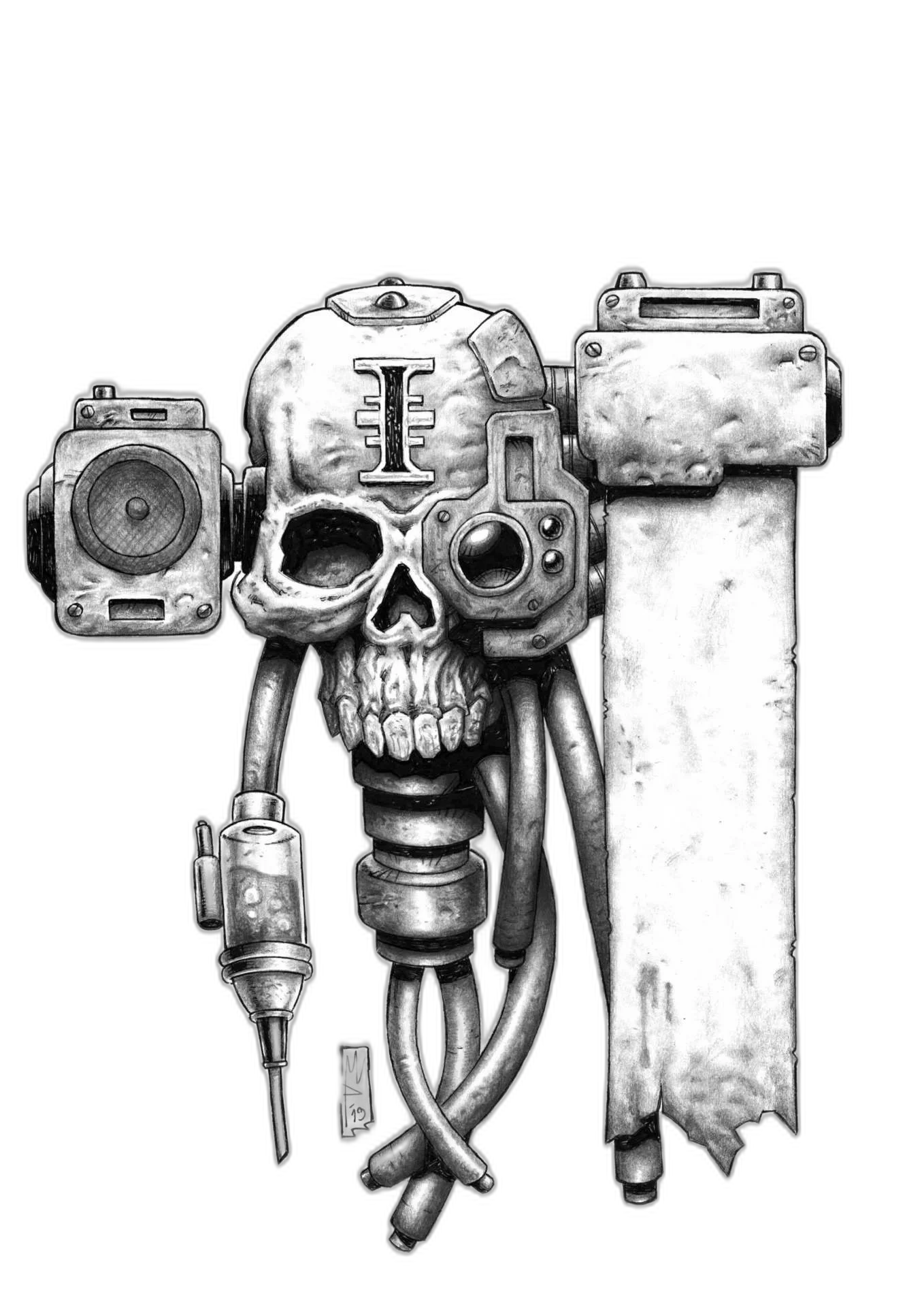
The servo-skull is among the most distinctive pieces of Imperial military equipment — a floating skull-cogitator hybrid, typically a real human or Adeptus Astartes cranium fitted with anti-grav suspensors, cogitator-cluster integration, and (most theologically dense) the brain-engram of a long-dead servant whose cognition continues to operate within the cogitator-spirit binding. The result is a thirty-centimetre floating sentinel that performs surveillance, credential-bearing, reliquary-attendant, and astropath antenna-shadow functions across every level of Imperial institutional life. The servo-skull is simultaneously a technological device, a spiritual relic, and an artefact of post-mortem servitude — and Imperial doctrine treats it as all three simultaneously.

An Inquisitorial servo-skull bearing the sacred 'I' sigil — relic-adjutant blessed to murmur the Emperor's word, suspended above the line in chained reverence.

Standard servo-skull patterns operate on internal cell power for approximately twelve hours autonomously, with longer endurance achievable through tether to a parent cogitator-array (the case for Adeptus Mechanicus credential-bearer skulls) or through periodic recharge from the wielder's armour or kit. The cogitator-spirit binding is the most theologically loaded element — the brain-engram of the servant who hosted the cognition before death continues to operate within the cogitator, providing continuity of service and (according to Mechanicus theology) a more reverent and reliable companion than any newly-built cogitator-spirit could provide. The servo-skull's "personality" — its quirks, preferences, occasional erratic behaviour — is the residue of the servant's mortal cognition expressing itself through the cogitator binding, and Imperial doctrine treats this as feature rather than malfunction.
Function variants serve different operational roles across Imperial institutional life. Combat surveillance servo-skulls are issued to Adeptus Astartes Captains, Astra Militarum regimental officers, and Inquisitor-grade individuals who require persistent overhead observation of their immediate operational environment; these skulls relay vox and auspex returns to the wielder's signum or equivalent. Mechanicus credential-bearer skulls accompany Tech-priest Magi as visible markers of authority — the skull's glyph-display projects the bearer's clearance level and institutional affiliation in ways that subordinate Mechanicus personnel can read and respond to without verbal exchange. Ecclesiarchy reliquary-attendant skulls accompany Cardinals and high-Confessors during processions, often suspending small relic-fragments beneath them on chains. Astropath antenna-shadow skulls, finally, exist as auxiliary cognition-extensions for senior astropaths — a more rare variant whose brain-engram was that of a junior astropath in life and whose cogitator-binding extends the senior astropath's perceptive reach during long Astropathic sessions.
Wielders span the full breadth of Imperial command and ecclesiastical authority. Adeptus Astartes Captains and Chapter Champions, regimental officers above Lieutenant grade, Inquisitors of all ordo (though Ordo Hereticus tends to favour fewer servo-skulls than Ordo Xenos), Tech-priest Magi from Archmagos to junior Tech-adept, Ecclesiarchy Cardinals and the more senior Confessors, Adepta Sororitas Canonesses — all of these may have one or more servo-skulls in their personal entourage. The most senior officials may have an entire entourage of skulls, each with a distinct function and a distinct brain-engram providing distinct operational capability. To meet a Tech-priest Magos walking with five servo-skulls in train is to meet an Imperial functionary of significant institutional weight.
Ritual treats each servo-skull as named and historic. The skull's identifying name is typically the servant's name in life; the cogitator-spirit's binding-rite is performed at activation by Tech-priest enginseer; the skull's service-history accumulates across operational tours and is documented in the wielder's personal records. A servo-skull lost in combat is mourned in proportion to the wielder's institutional position — a junior officer's lost servo-skull is recorded but not extensively investigated; a Chapter Master's lost servo-skull spawns institutional grief and dedicated retrieval missions of substantial scale. The skulls of certain famous Imperial officials — those of Captain Tycho (Blood Angels tradition holds three skulls in Tycho's traditional entourage), various Inquisitorial entourage skulls associated with named Inquisitors, the credential-skulls of senior Mechanicus Magi — accumulate over time into named relics in their own right.
Limits and vulnerabilities are doctrinally rehearsed. Servo-skulls are vulnerable to psychic suborning — the Chaos-tainted cogitator-spirits of Heretical sorcerers and the genestealer broodmind have both demonstrated capacity to suborn weaker servo-skull bindings and use them as listening-posts within Imperial institutional space. Standing protocols mandate periodic ritual-purification of servo-skulls operating in Chaos-exposed warzones, and the wielder is required to report any unusual behaviour to the Mechanicus enginseer attached to his command for diagnostic evaluation. Warp-translation degrades brain-engram coherence in ways that, over many translations, can erode the servo-skull's cognitive function until eventual decommissioning is required — a long, slow degradation that the wielder may need to mourn even as he replaces the skull with a successor pattern.

Teleport-Homer

The teleport-homer is the most strategically loaded piece of equipment in the Imperial tactical arsenal — a translocation beacon, typically forty centimetres long and gilded with iron-and-bronze sigil-engraving, that projects a stable warp-locus into which the teleporter-bays of an Adeptus Astartes Strike Cruiser can drop their elite formations with five-metre or better precision. Without a homer, teleporter-deployment of strike-teams achieves only fifty-metre or worse drift radius, often catastrophic in the confined urban or subterranean conditions where teleport-deployment matters most. With a homer, the team arrives within five metres of the homer-position — close enough for immediate combat engagement, far enough to avoid landing on top of the homer itself. The teleport-homer is therefore the difference between strategic teleport-strike and tactical teleport-disaster.

Standard pattern teleport-homers are produced exclusively in Adeptus Mechanicus forge-cathedrals and are issued only to formations entitled by doctrine to draw them — Astartes Terminator squads, Vanguard Veterans deploying with strike teams, Adeptus Astartes Apothecary deployments where teleport-extraction is the planned recovery method, Inquisitorial Acolytes operating under Strike-Cruiser support, and occasionally Adepta Sororitas Repentia squadrons whose Sacred Standard Cannoness has prearranged teleport-extraction. The homer is forty centimetres long, weighs approximately eight kilograms when fully fluid-loaded (the warp-locus stabilisation requires liquid coolant baths within the device), and operates on internal cell power for approximately thirty minutes before requiring recharge at a Forge facility.

The function is theologically dense as well as technically demanding. The homer must be activated and ritually-blessed in advance of deployment by a Mechanicus enginseer; the cogitator-spirit within is calibrated to the specific Strike Cruiser whose teleporter-bay it will guide; the warp-locus projection requires that the homer be in stable line-of-warp with the Strike Cruiser at the moment of teleport, which means the Strike Cruiser must be in orbit or close-orbital position relative to the operational theatre. The strike-team plans its operation around these constraints — the homer is dropped or carried into position, the strike-team confirms the cruiser's orbital window, and the teleport-deployment occurs within the operational window when all three (homer, cruiser, theatre) are aligned for stable warp-locus projection.

Tactical use of the teleport-homer follows established Astartes doctrine. A forward operative — typically a servo-skull, a Scout, or in Inquisitorial cases an Acolyte — carries or deploys the homer to a target position in advance of the strike. The strike-team confirms the homer's activation and stable warp-locus through vox or signum communication, then the Strike Cruiser teleporter-bay drops the team onto the homer-position with the precision the homer guarantees. The full sequence — homer-deployment to teleport-arrival — typically takes between fifteen and ninety minutes depending on operational complexity, with the homer-deployment phase being the most vulnerable period (the operative carrying the homer is, by definition, deeper into enemy territory than the strike-team's eventual position).

Risk and counter-measures dominate teleport-homer doctrine. A captured homer yields catastrophic intelligence — its cogitator-spirit holds the warp-locus calibration for the parent Strike Cruiser, allowing enemy forces with sufficient sophistication to project counter-loci and intercept future teleport-deployments at the Cruiser's expected operational windows. Imperial doctrine therefore mandates self-destruct: every homer incorporates a small-charge dispersion mechanism that triggers automatically if the homer is tampered with by anyone other than its operating Imperial wielder. The protocol is doctrinal absolute — operatives carrying homers are required to acknowledge the self-destruct trigger in writing before being issued the device, and the consequences of failure to maintain self-destruct readiness are punished as doctrinal failure even if no actual capture occurs.

Specialised variants exist at the margins of standard issue. Heresy-era teleport-homers offered substantially longer range than modern variants — Cruiser-to-homer warp-locus stable up to a planetary surface from high orbit rather than the close-orbital constraint that limits modern variants. Those patterns were lost in the Heresy and modern manufacture cannot reproduce them. The Mk.IV Cawl-pattern homer, deployed across some Indomitus Crusade formations, achieves three-metre or better arrival precision (rather than the five-metre standard) through optimised warp-locus projection algorithms, but its operational range remains close-orbital. Other minor variants exist for specific Chapters and Inquisitorial cells — none fundamentally alter the homer's role, but each represents specific institutional preferences in cogitator-spirit binding and ritual-treatment.

Banners and Iconography

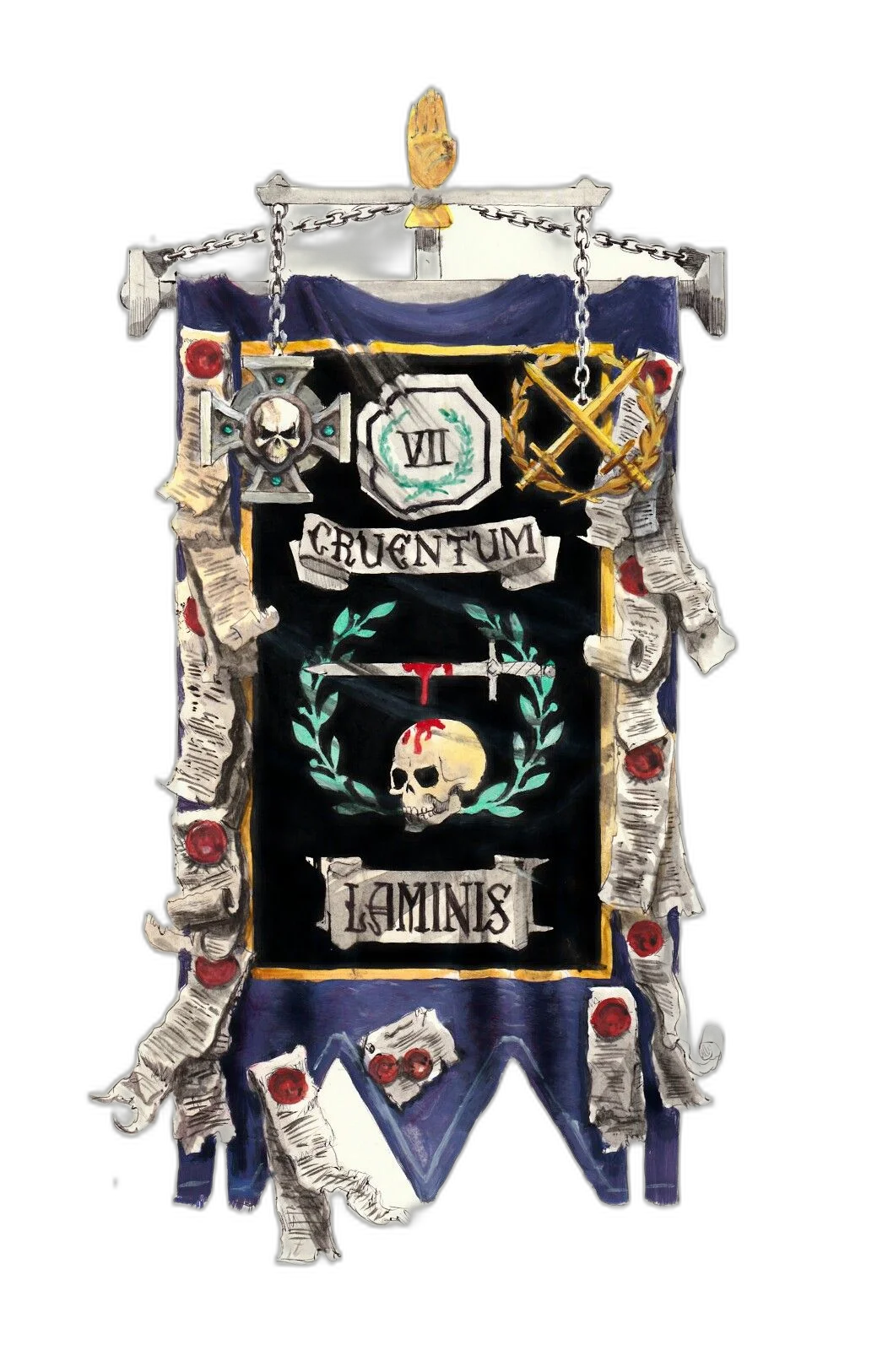
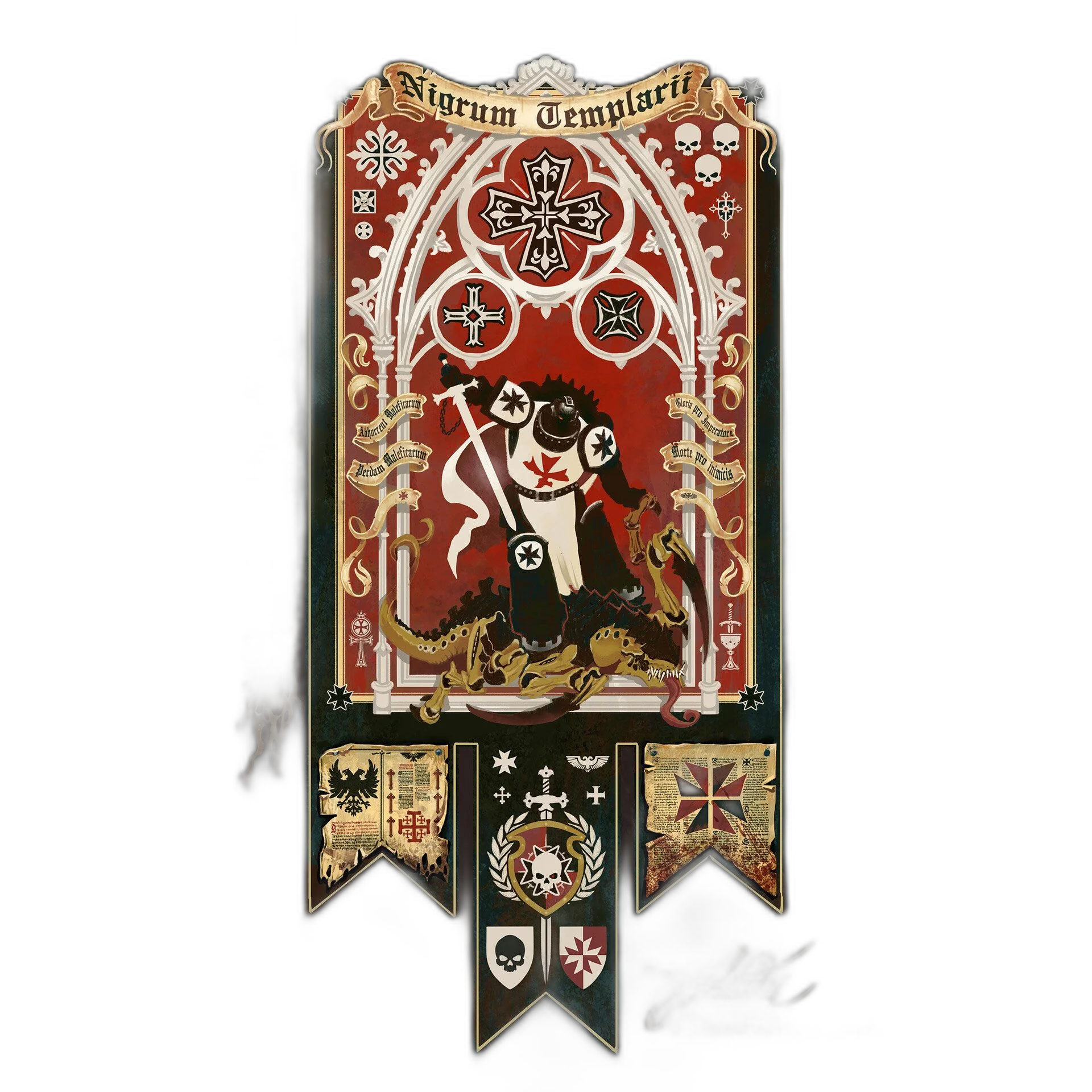
The iconography-banner is among the oldest and most theologically loaded items in the Imperial tactical arsenal — the consecrated cloth of Imperial identity, varying in scale and significance from the regimental banner of an Astra Militarum line unit to the Sacred Standard of an Adeptus Astartes Founding Chapter, but uniform in its institutional weight: every banner is sacred, every banner blessed, every banner the visible incarnation of its bearing-formation's identity in the field. The Standard Bearer who holds the banner is, in long Imperial doctrine, holding nothing less than his unit's institutional soul made cloth.

The iconography-banner of the Black Templars proclaims the chapter's vow rendered in Reliquary Gold — heraldry the warp itself will not refuse to recognize.

Adeptus Astartes banner-traditions partition the various scales of unit-identity. The Chapter banner is the singular cloth-relic of the Chapter, carried only by the Chapter's Honour Guard and present only in the most significant engagements; its loss in battle is catastrophic institutional grief, and dedicated retrieval missions of substantial scale follow immediately. Company banners exist at the next tier — each Company maintains its own banner, carried by the Company's standard-bearer and present in essentially every Company-scale engagement. Sacred Standards are named relic-banners that have crossed the threshold from cloth-of-identity to cloth-of-relic — the Standard of Sanguinius held by the Blood Angels is the canonical example, with similar named Standards held by other Founding Chapters and treated with grade equivalent to a primary reliquary.
Astra Militarum banner-traditions parallel the Astartes structure but with significantly different institutional density. Each regiment maintains its regimental banner, carried by the Color Sergeant — a position of honour that is often hereditary within Imperial Guard families across multiple generations of service. Schola Progenium graduation banners are presented to each cohort of Imperial Guard officer-graduates at commission, and are carried by those graduates throughout their subsequent service as visible markers of their Schola Progenium education. Cadian, Catachan Jungle Fighters, Death Korps of Krieg, and other regional Imperial Guard traditions all maintain distinctive banner-patterns specific to their cultural and institutional identity, with the Cadian Sacred Standard recovered at Cadia's fall now serving as the institutional relic of all Cadian-survivor regiments.
The morale function of the iconography-banner is the most documented and operationally significant aspect of its role. Within approximately thirty metres of a banner, troops fight harder, retreat slower, and absorb more casualties before breaking — the Departmento Munitorum's casualty-rate analysis has documented this effect across hundreds of comparison engagements, with banner-equipped units consistently demonstrating reduced rout-rates, extended engagement-tolerance, and elevated combat effectiveness. The mechanism is partially psychological (visual focus on the banner reinforces unit cohesion) and partially canon-supported supernatural (the banner's Mechanicus-blessing and Ecclesiarchy-consecration provide a minor protective machine-spirit aura whose effect, though small, is documented and reproducible across Imperial military experience).
The standard bearer is, in long doctrine, an institution of honour. The Astartes Honour Guard's banner-bearer is selected from among the Chapter's most veteran brothers; the Astra Militarum Color Sergeant is similarly selected for service-history and demonstrated character; the Adepta Sororitas Banner-Sister is a position of order-honour within the Sister convent. Failure of the banner-bearer to defend the banner is doctrinal failure of substantial gravity — the banner-bearer who lives while the banner is lost is judged as having failed his sacred duty, and may be removed from his role even if his combat performance was otherwise exemplary.
Banner-fall in active battle is omen — the visible loss of a banner in field combat triggers immediate institutional response. Imperial standing orders permit (and in some Astartes traditions, mandate) berserker-rage in retrieval — the soldiers near a fallen banner are doctrinally encouraged to attempt retrieval at substantial personal risk, with the casualty-rate cost of such retrievals understood to be balanced by the institutional cost of permanent banner-loss. Some Astartes Chapters codify the retrieval-rage as part of formal combat doctrine; the Blood Angels tradition, with its blood-frenzy heritage, treats banner-fall retrieval as one of the canonical triggers for Sanguinary Black Rage rather than as a controlled tactical response. Sacred Standards are particularly intense in the institutional response their loss provokes — the loss of a named Sacred Standard can spawn a Crusade of substantial scale dedicated specifically to recovery or vengeance.

Purity Seals

The purity-seal is the most universally distributed sacred item in Imperial military service — devotional parchment scrolls, ten to fifteen centimetres long, ribbon-bound and fastened to the wearer's armour with wax seal of Chapter or regiment, declaring oath, blessing, or absolution made visible to all who can read the soldier. Every Adeptus Astartes battle-brother wears at least one; veterans accumulate dozens across decades of service, layering the parchment across pauldron, breastplate, helm, and weapon until the armour is more parchment than ceramite in some cases. Astra Militarum officers and Schola Progenium graduates wear smaller numbers but with equivalent institutional weight; Adepta Sororitas Sisters wear seals that integrate the orders' specific theological framings into the broader Imperial purity-seal tradition.

Eight purity seals chained to the standard — every oath sworn before the Emperor and pressed into wax that the brother shall not break.

The standard pattern is parchment of medium-grade Imperial linen, hand-written by Chaplain or Confessor (occasionally self-written at moment of oath), ribbon-bound through reinforced grommets at one end, sealed at the binding with wax bearing the issuing institution's sigil. The text varies — common patterns include declaration of personal oath ("I swear by Sanguinius that I will not retreat from this line"), blessing of the wearer ("May the Emperor of Mankind guide my hand"), absolution from prior failure ("My duty in the previous engagement is forgiven; I rise blessed for this one"), or commemoration of named saints and primarchs whose example the wearer commits to follow. The text is always visible to other soldiers — purity-seals exist in part to communicate institutional identity to brothers and superiors who can read at a glance the wearer's commitments and institutional position.
The function of the purity-seal is partly morale-multiplier and partly Mechanicus-blessed minor protection. The morale aspect parallels the banner — a soldier wearing visible purity-seals demonstrates institutional commitment to himself and to his brothers, reinforcing personal resolve through visible token of duty. The Mechanicus-blessed protection is canon-supported but small — the consecrated parchment, by Mechanicus theology, provides a faint protective resonance that the wearer's armour-spirit recognises and integrates with its own protective capability. The effect is small enough that no Imperial doctrine treats purity-seals as substantial physical protection, but it is real enough that veteran Astartes and Imperial Guard officers maintain their seal-collection with deliberate care across decades.
Issuance is performed by Chaplain or Confessor at pre-deployment ritual, by Cardinal at major institutional ceremonies, or by self-issuance at the moment of personal oath (the soldier writing his own oath on a personal parchment, which may then be ritually sanctified by the unit's Confessor at the next institutional opportunity). The Astartes oath-of-the-mission seal worn by Sergeants and Captains during specific named engagements is the canonical example of self-issued seal that subsequently receives institutional ratification — the Sergeant writes the oath at moment of decision, the seal is added to his armour, the Chaplain blesses the seal at the next institutional opportunity, and the seal accompanies the Sergeant's armour-collection thereafter as a record of the engagement.
Damage to a purity-seal is doctrinally significant. A torn, burned, or otherwise damaged purity-seal must be re-issued — the seal cannot simply be removed without proper rite, because the institutional commitment the seal documents persists even if the parchment is destroyed. The Chaplain or Confessor performs a rite-of-re-issuance that retires the damaged seal (typically through ritual burning) and replaces it with a new seal bearing the equivalent oath. Astartes who have suffered substantial seal-damage in major engagements often carry the rite-records of damaged-seal re-issuance as institutional history — a Veteran Sergeant whose seal-collection has been re-issued forty times across his service-history is, by long Astartes tradition, more honoured than one whose original seals have remained intact, because the damaged-seal collection records combat experience that the intact collection does not.
Variants exist for specific institutional contexts. The Adepta Sororitas Convent-Issued seal incorporates Sororitas-specific theological framings (the wax-seal sigil being the convent's, the parchment-text emphasising the order's particular doctrinal commitments). The Inquisitorial Acolyte seal is smaller and less visible, often worn beneath outer garments, reflecting the clandestine nature of much Inquisitorial work. The Astartes Chaplain's blessing-of-others seal is presented to brothers at moments of institutional need (return from heretical-wound rehabilitation, restoration to active service after Mercy-deferral, similar moments of institutional re-affirmation). Each variant is Mechanicus-recognised and Ecclesiarchy-sanctioned within its institutional context, with cross-context use generally permitted but rare.

Data-Slate

The data-slate is the most administratively versatile piece of equipment in Imperial military service — a leather-bound cogitator slate, twenty-five by eighteen centimetres, single-button activation, multi-page scroll, that stores orders, maps, codex extracts, bestiary scans, requisition forms, and the broader text-and-low-resolution-imagery library that an officer needs for informed conduct of long campaigns. The data-slate is to the Imperial officer what the bestiary scroll was to the pre-Imperial military scribe — an extension of organisational memory, condensed into hand-portable form, accessed through cogitator-spirit interrogation rather than through written page-turning.

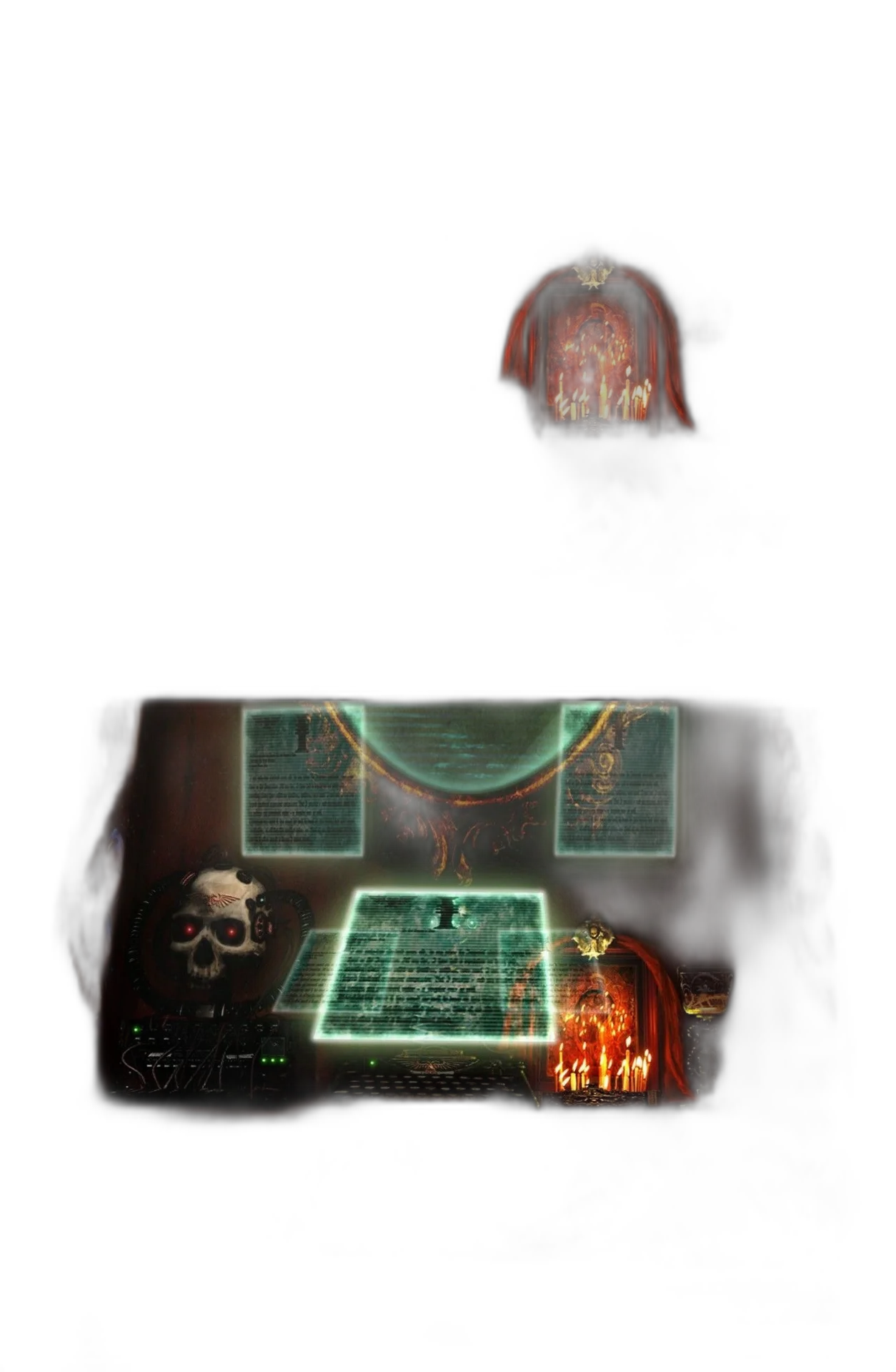
An Imperial cogitator-shrine activates — its data-slate blooms with sacred glyph-script while servo-skull and candle-reliquary attend the litany of bytes.

Standard pattern data-slates have a leather-bound external case incorporating a hardened cogitator-cluster, a small hololith-display capable of low-resolution monochrome or two-colour imagery, a single-button activation that initiates the cogitator-spirit's response, and an internal cell that powers approximately seventy-two hours of continuous use before requiring recharge. The cogitator-spirit within is more limited than that of an auspex or signum — its function is text-and-imagery retrieval rather than active battlefield analysis — but its theological status is no less elevated. Each data-slate is Mechanicus-blessed at activation; its sub-rite operating system runs prayers in machine-binary that the Adeptus Mechanicus enginseer attached to the unit verifies periodically.
Wielders span every level of Imperial command and administration. Adeptus Astartes Sergeants and above carry data-slates as standard kit; Imperial Guard Lieutenants and above carry them as commission-issue; Tech-priests carry specialised data-slates with extended cogitator-capacity for their administrative work; Inquisitorial Acolytes carry slates configured for their clandestine operational needs; Adept-scribes within the Departmento Munitorum, the Adeptus Administratum, and the Ecclesiarchy carry slates that may be the entire technological footprint of their administrative function. The data-slate is, in this sense, the most universally distributed cogitator-bearing equipment in the Imperium — more common than auspex (which is military-issue) and certainly more common than signum (which is officer-issue).
Function variants serve different operational contexts. The military data-slate carries orders-of-the-day, tactical maps, bestiary entries, and the standardised codex extracts that the soldier needs for combat operations. The Tech-priest data-slate carries technical specifications, machine-spirit reverence litanies, forge-pattern blueprints, and the broader Mechanicus institutional reference library at scaled-down resolution. The Inquisitorial data-slate carries case files, suspect profiles, theological-deviation references, and the Inquisitor's working notes — its security profile is the highest of any data-slate variant, with multi-key encryption and self-destruct mechanisms appropriate to the sensitive information it carries. The Adept-scribe data-slate is the simplest variant, carrying primarily administrative forms and the procedural references the scribe needs for his daily clerical work.
Limits and vulnerabilities are honestly catalogued. Text-only or low-resolution display means the data-slate cannot serve the role of a full hololith-cogitator; tactical hololithic projection requires the larger cogitator-array (treated separately in the sensors-communications page). Vulnerability to electromagnetic-interference and Chaos cogitator-corruption is real — both can render the data-slate's stored information unreliable or actively misleading, with the soldier wielding a corrupted slate at risk of acting on falsified data. The Mechanicus periodically audits data-slate integrity at Forge facilities to verify that the stored content has not been corrupted by ambient warp-bleed or by unauthorised modification.
Heresy-era data-slates offered substantially broader cogitator-capacity than modern variants — pre-Heresy data-slates incorporated more sophisticated cogitator-spirit binding and significantly larger storage capacity, allowing them to function more nearly as full cogitator-arrays in their own right rather than as the limited information-retrieval slates of modern manufacture. Those patterns were largely lost during the Heresy and the Age of Imperial Restoration, and modern data-slates are simpler shadows of their ancient predecessors. Officers and scholars who have seen pre-Heresy data-slates in restricted Imperial archives report being startled by how much information the older patterns could carry — a disquieting reminder of the broader pattern of Imperial technological regression that haunts so many institutional traditions.

Reliquaries

The reliquary stands at the apex of Imperial tactical wargear — a portable container holding a sacred relic, gilded ironwork box and jewelled and banner-suspended or honour-guard-carried, twenty to sixty centimetres in dimension depending on the relic it bears, and treated with grade equivalent to a primary Sacred Standard in the institutional hierarchy of Imperial sacred objects. Where the iconography-banner carries institutional identity, the reliquary carries institutional memory itself — the recovered finger-bone of a saint, the primarch shard of a fallen primarch, the blessed icon recovered from a heretic shrine, the daemonhead trophy of an exorcism. Each reliquary is a relic in the strict theological sense, and each is treated by every Imperial institution with reverence proportionate to the relic it contains.

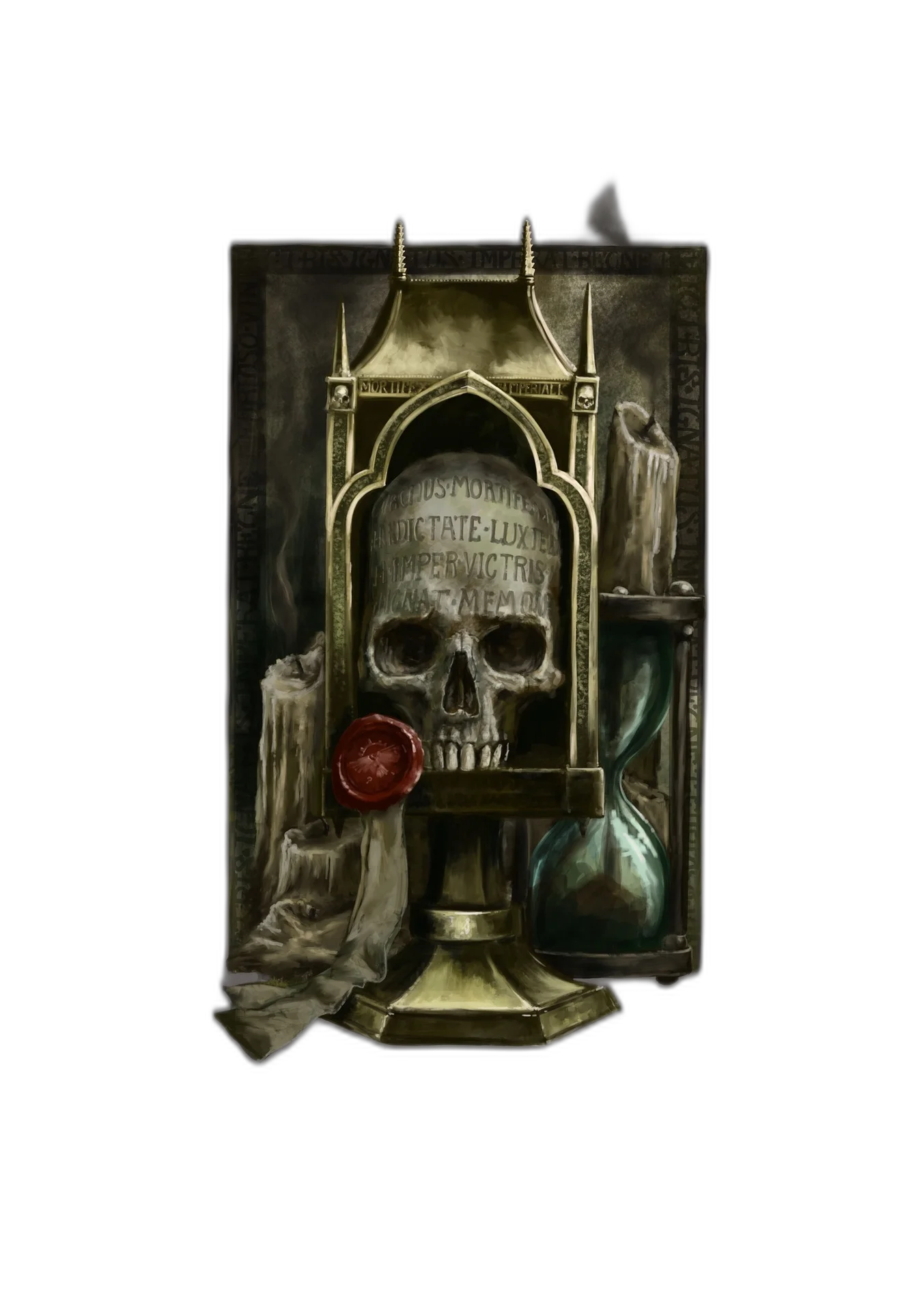
A gilded gothic reliquary cradles a sanctified skull beneath Latin invocations — its wax-sealed scroll and guttering tapers attesting the saint's enduring vigil.

Standard reliquary form is an iron-and-bronze box with gilded ornamentation, jewelled studs marking its institutional consecration, often with hinged or sliding access for the rare circumstances when the relic must be displayed or invoked. Smaller reliquaries (twenty-centimetre scale) are carried by Chaplains in the field, used for direct invocation during prayer or battlefield blessing; larger reliquaries (sixty-centimetre scale) are carried by Honour Guard formations or by suspension-cogitators with anti-grav suspensors, used in ceremonial procession or in the most significant institutional engagements. Some reliquaries are integrated with banners — the Sacred Standard of a Founding Chapter often incorporates a reliquary at its base, with the relic adding its consecrated weight to the banner's morale-multiplier function.
Function in active warfare combines morale-multiplier role with canonical battlefield miracle effect. When the bearer prays over the reliquary in active battle, the combination of machine-spirit blessing (the reliquary itself), faith-resonance (the relic within), and the bearer's institutional position (typically Chaplain or Confessor with high theological standing) produces a minor protective aura whose effect is documented in canon battlefield-record and reproduced consistently across centuries of Imperial military experience. The aura is not large — extending only a few metres around the bearer — but within its radius, troops fight harder, fear less, and resist heretical influence at meaningfully elevated rates. This is not the morale-effect of the banner; it is a more specifically theological effect, dependent on the relic's particular sacred associations.
Wielders are restricted by Imperial doctrine to ecclesiastical and theologically-authorised institutional roles. Chaplains within the Adeptus Astartes tradition carry reliquaries during their pastoral and combat-spiritual duties; Cardinal-grade Ecclesiarchy officials carry reliquaries during major ceremonial and operational engagements; Confessors of grade Senior or above carry reliquaries during Inquisitorial-supported operations; Adepta Sororitas Canonesses carry reliquaries as part of their order-leadership role. Lower-tier soldiers do not carry reliquaries in the technical sense — they may participate in the reliquary's consecration or invocation, but the bearing role itself is restricted to the spiritually-credentialed.
Maintenance is the responsibility of the Ecclesiarchy Relic Master — a position of significant institutional weight at the Chapter, convent, or regional level. Each reliquary is catalogued in the Relic Master's archives with full provenance documentation: the relic's name, its discovery or recovery history, its authentication record (verified by Inquisitorial archaeo-investigators when the relic's age or origin warrants), its consecration history across whatever institutional moves it has experienced, and its operational service record. The catalogue-network across the Imperium permits any Imperial institution to verify a claimed relic against the broader historical record — a reliquary that does not appear in the catalogue is presumed inauthentic until investigation can establish its provenance.
Famous reliquaries serve as institutional anchors for entire Chapter or order traditions. The finger-bone of Saint Celestine, the primarch shard of Sanguinius held by the Blood Angels, the Skull of Sebastian Thor held by the Adeptus Ministorum since the late M36 — these and similar named relics are treated as relics-of-the-Imperium rather than as merely Chapter-relics. Their loss in any institutional context spawns institutional grief proportionate to their significance, with the most significant relic-losses triggering Crusades dedicated specifically to recovery or vengeance. The institutional response to relic-loss is often the largest-scale operational response that any single equipment-loss event produces in the Imperial military — the loss of a Sacred Standard rivals it, but few other losses approach this institutional scale.

Devotion, Custody, and Duty

Devotion structures every aspect of tactical wargear handling across the Imperium. Each item is treated as sacrament — the data-slate is not a tablet, the banner is not cloth, the seal is not paper, the reliquary is not a container. Misuse of any tactical wargear item is heresy of the lesser sort or worse: cursing one's data-slate in frustration is heresy of the lesser sort and earns Sergeant rebuke; defacing a banner outside ritual context is heresy capital and earns Inquisitorial intervention; mishandling a reliquary outside Ecclesiarchy-authorised contexts is heresy of the highest grade and may earn execution. The hierarchy of severity tracks the institutional weight of the item, and Imperial doctrine is unforgiving in its application of the appropriate response.

Ecclesiarchy on the field — the censer swings in benediction, hooded priests raise relic-skulls and bound prayers, sanctifying the wargear of the faithful before the next muster.

Chain-of-custody documentation traces every reliquary, named banner, and named servo-skull across institutional time. The Ecclesiarchy maintains the reliquary catalogue, the Astartes Chapter Master maintains the banner-record for his Chapter's institutional Standards, the Tech-priest enginseer maintains the cogitator-spirit binding records for the senior servo-skulls in his command. Loss of any catalogued item triggers immediate institutional response — accountability is investigated, retrieval is planned, and the loss is documented in the broader Imperial record. There is no anonymity in tactical wargear loss; every named item that disappears from active service is investigated and the responsible parties are identified, even when the loss was beyond their control.
Cross-faction protocols apply when Astra Militarum and Adeptus Astartes formations operate together. The Astra Militarum banner falls within thirty metres of an Astartes formation triggers Imperial standing-orders that require the nearby Astartes squad to assist in retrieval — even if the squad's primary mission is unrelated, the banner-rally protocol overrides standard squad-tasking until the banner is secured. The protocol works in reverse as well, with Astra Militarum formations rallying to nearby Astartes Sacred Standards in conditions of mixed-formation operation. These cross-faction rally protocols are taught at every Imperial military institution and are practised regularly — the cohesion they provide is doctrinally substantial.
Heretical corruption response follows a distinct doctrinal framework for tactical wargear. Banner-defacement by Chaos forces — the painting-over of Imperial sigils, the inversion of consecrated images, the deliberate exposure of the cloth to daemon-presence — is heresy of capital grade and the response is invariably retrieval-and-purification or destruction-by-purifier-fire. Servo-skull corruption — the suborning of the cogitator-spirit by Heretical sorcery or genestealer broodmind — requires Mechanicus exorcism, with the affected servo-skull either purified and re-blessed or destroyed depending on the severity of the corruption. Reliquary corruption — the rare and grim event of a sacred relic falling into Chaos hands and being subjected to Heretical use — triggers the largest institutional response of any tactical-wargear corruption case, with Inquisitorial Crusade and substantial Astartes formation-deployment dedicated specifically to recovery or destruction.
The Sacred Hierarchy among tactical wargear items is a recurring framework in Imperial doctrinal texts. From most-sacred to least-sacred: reliquary > Sacred Standard / Chapter banner > regimental banner / company banner > named servo-skull > teleport-homer > data-slate > purity-seal. The hierarchy is not absolute — context modifies it (a Chapter Master's personal data-slate is more sacred than a junior soldier's purity-seal even though the data-slate sits below the seal in the abstract hierarchy) — but the framework structures institutional decision-making in conditions of conflicting priorities. When a Chaplain must choose what to save during a controlled retreat, the hierarchy guides his choice; when a Relic Master must decide what to investigate first after a major loss event, the hierarchy structures his triage.
Beyond the standard institutional framework, the Adepta Sororitas orders maintain their own parallel keeper tradition with substantial overlap but distinct emphasis. Sororitas Sacred Standards are treated as reliquary-grade rather than as standard banners, reflecting the orders' Ecclesiarchy-grade institutional position; Sororitas reliquaries are catalogued by the orders' own Relic Master tradition rather than by the broader Ecclesiarchy hierarchy; Sororitas data-slates carry order-specific doctrinal references that the broader Imperium does not always share. The Sororitas tradition coordinates with the broader Imperial framework but maintains its institutional voice — a pattern that traces to the orders' particular post-Sebastian-Thor-reformation position within the Ecclesiarchy hierarchy and that has proved stable across millennia of Imperial institutional development.