In the grim darkness of the far future, there is only war
The augur-cogitators of the Imperium — auspex, signum, vox-caster, micro-bead, cogitator-array. Mechanicus-blessed extensions of mortal sense, the difference between hunter and prey, between held line and broken rout in the long night of M41.
Contents
Contents
Contents
Contents
The Extended Senses of the Imperium
In a galaxy where the Warp swallows light-years of communication and the Chaos-tainted enemy walks unseen through veils of psychic deception, the soldier of the Empire who relies on his unaided eye and ear is already dead. From the corridor-fights of hive-world ground combat to the void-cold engagements of boarding action, the augur-cogitator is the difference between the line that holds and the line that breaks. Sensor and communication equipment, blessed by the Adeptus Mechanicus and issued from forge-world to fighting front, extends the soldier's perception beyond the natural — and in doing so, often spares him from the death that awaits the unsensored.
The strategium where the regiment's senses are united — officers reading the auspex-litany that keeps the Imperium's eye open.
Imperial sensor doctrine is structured around four ascending tiers of equipment, each addressed to a specific scale of warfare. The micro-bead serves the squad — discreet vox-traffic between brothers within twenty paces. The vox-caster serves the platoon and the regiment — long-range transmission across kilometres of battlefield, the shoulder-borne cogitator that ties the Sergeant's voice to the Captain's ear. The signum serves the officer — an aggregating array that draws the squad's auspex returns into a single tactical overlay, sharpening fire-discipline by an order of magnitude. The cogitator-array, finally, serves the vehicle and the installation — a sensoria-cluster orders of magnitude more powerful than the handheld auspex, capable of resolving false signatures and computing fire-solutions across whole battlefields.
This stratification matters more than any catalogue of ranges and yields. A Astra Militarum regiment whose Voxman has fallen and whose officers have lost their signums is no longer a regiment but a mob — every fire-team an island, every Lieutenant blind to the company beside him. A Adeptus Astartes strike force whose Sergeants no longer hear their Captain's auspex-feed walks into ambushes that the cogitator-array would have warned of. To deny the enemy his sensors is to dismember him; to lose your own is to be dismembered.
Beyond the four tiers stands the singular case of the auspex itself — handheld, multispectral, the most personal of all augur-cogitators. Every Astartes carries one; every Lieutenant carries one; every Inquisitorial Acolyte and Ecclesiarchy field-confessor carries one. The auspex is not a piece of equipment but an extension of the soldier's own perception, sweeping forty metres of corridor for thermal returns, chem-trace, bio-signatures of the Genestealer or the Tyranid lictor that no eye could detect. The Astartes who steps into a corridor without first sweeping with auspex is the Astartes who dies in that corridor. There is no canonical record of a senior officer ordering a sweep to be skipped on grounds of speed.
Above all, sensors and communications are not commodity electronics but sacred instruments. Each device is consecrated at the forge, blessed by tech-priest at activation, anointed with sacred oils across its frequency crystals and sensoria-cogitators. The vox-channels are sanctified frequencies; the auspex returns are revelations. To curse one's vox in frustration is heresy of the lesser sort, but heresy nonetheless — a soldier who breaks his auspex in anger faces summary punishment from his Sergeant before he faces the enemy. The instrument extends the Emperor of Mankind's sight, and the Emperor of Mankind's sight is not to be insulted.
Mechanicus Patronage and STC Heritage
Imperial sensor and communications technology rests on foundations laid in the Dark Age of Technology and recovered, fragment by fragment, in the long centuries of Mechanicum reconstruction. The auspex itself is a recovery — its core sensoria-cogitator pattern reconstructed from a Standard Template Construct dataset preserved on a forge-world that survived the Age of Strife when most others did not. The vox-caster is older still: its sub-etheric transmission protocol descends from a pre-Imperial communication science that the Adeptus Mechanicus has spent ten thousand years refining, blessing, and maintaining without fundamentally altering. What the Imperium fields today is, in essential pattern, what humanity fielded before the long dark — but humbler, more sacred, and considerably more reverent of the cogitator-spirits that animate the systems.
The Cult Mechanicus that taught the Imperium to listen — every sensor pattern recovered from STC heritage is a sacrament of restored lore.
The Great Crusade saw the first standardisation of sensor and communications equipment across all Imperial forces. Before the Crusade, individual human worlds had maintained their own incompatible vox-protocols and proprietary auspex patterns; the Mechanicum, in coordination with the early Imperial Army logistics organs, codified a single Imperial Cipher and a unified family of auspex frequency-bands that all loyal forces would share. By the time the Legions reached the galactic east, an Astartes Sergeant could speak by vox to an Imperial Army auxilia officer of any world they had brought into compliance, and the auspex returns of an Ultramarines scout could be read on the signum of an Imperial Fists Captain without translation. This standardisation was an act of administrative violence as much as of engineering — older systems were not adapted but replaced, the worlds that had preserved them either submitting or being broken.
The Horus Heresy tested this standardised system catastrophically. Traitor Legions, possessing the same equipment as loyalist forces, used the shared Cipher to spread misinformation, sow confusion, and intercept loyalist communications across the early phases of the war. After the Heresy, the Imperial Cipher was rebuilt from foundations — multi-layered, clearance-stratified, rotated weekly at minimum and hourly in active warzones. Every loyal forge-world received the new protocols; the auspex frequency-bands were similarly refactored to defeat traitor receivers. The cost of this rebuild was measured in centuries of partial Imperial communications failure during the Age of Imperial Restoration, but the resulting system has held against every subsequent threat — Chaos, Eldar, Necron, xenos cunning of every variety — for nine and a half millennia.
The Indomitus Era, beginning with Roboute Guilliman's awakening at the close of M41, brought the most significant refinement of Imperial sensor and communications equipment in living memory. The Mk.IV pattern auspex, designed by Belisarius Cawl's tech-magos collaborators, incorporates anti-Warp filtering and improved signal coherence under Chaos-tainted conditions; the Mk.IV vox-caster offers a fifty-percent extension of effective range over the Mk.III pattern through an optimised antennae geometry that took the Mechanicus three centuries of post-recovery analysis to produce. These are not new technologies — every component is reconstructed from older STC fragments — but they represent the first significant Imperial sensoria upgrade since the late M37, and their distribution across the Indomitus Crusade has reshaped the practical experience of Imperial command on a thousand fronts.
Throughout this long history, the Adeptus Mechanicus has remained the singular custodian of sensor and communications technology. Every auspex, every vox-caster, every signum and cogitator-array carries the Cog Mechanicum stamp of forge-world manufacture. No other Imperial institution is permitted to design, fabricate, or fundamentally alter the equipment — the Departmento Munitorum may issue it, the Astra Militarum may use it, the Adeptus Astartes may carry it into battle, but only the Mechanicus may build it. This monopoly is not bureaucratic but theological: the cogitator-spirits within these instruments are sacred to the Omnissiah, and only the Mechanicus possesses the lore of their proper interrogation. To attempt independent manufacture of even a single auspex outside Mechanicus sanction is technological heresy of the highest grade — a charge that has destroyed more than one industrialist house across the millennia.
Auspex
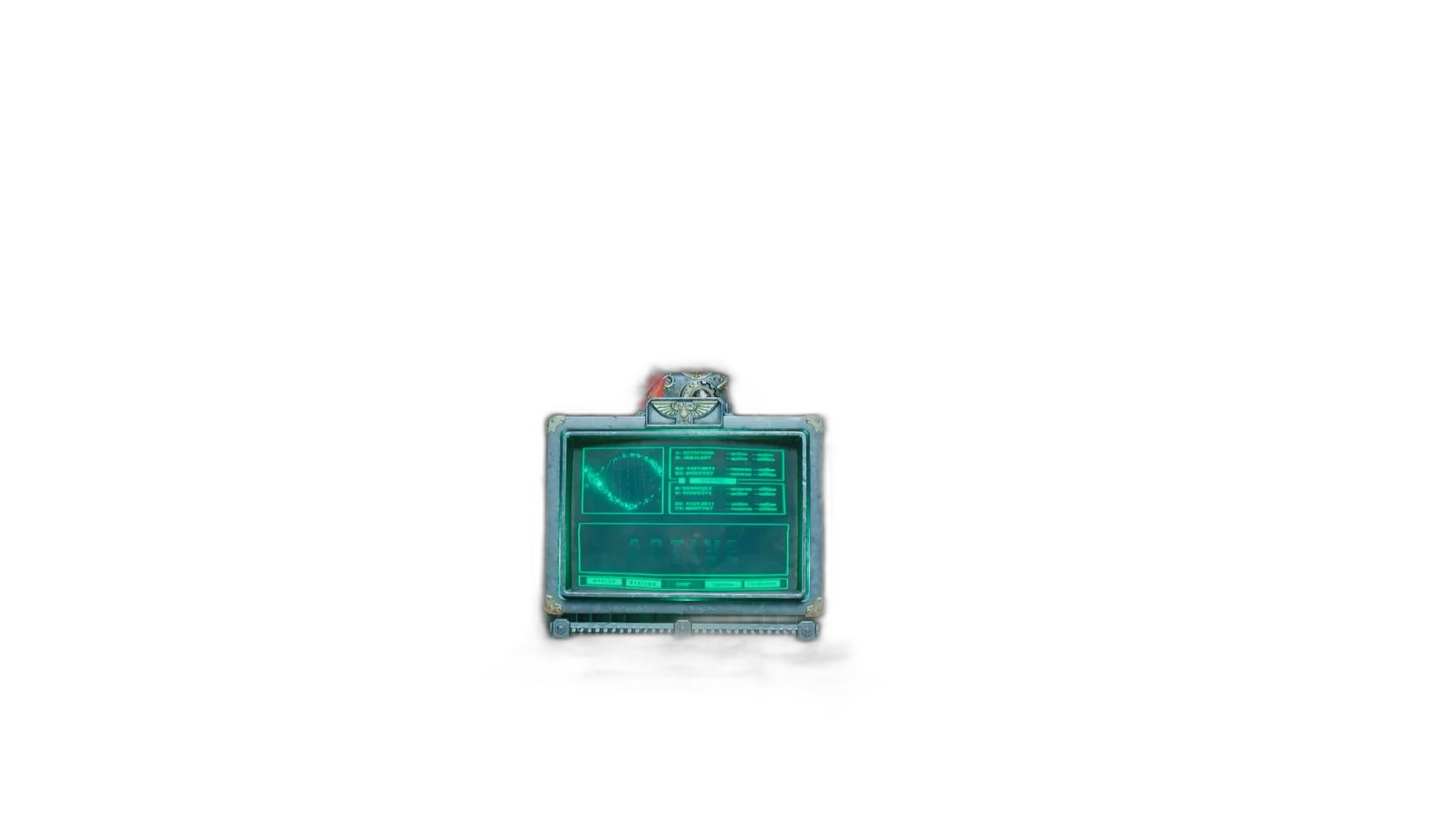
The auspex is the most personal of all Imperial augur-cogitators — a handheld device, roughly the size of a soldier's forearm, that combines electromagnetic, thermal, chem-trace, and bio-signature sensoria into a single multispectral sweep. Where larger augur-systems serve vehicles and installations, the auspex serves the soldier himself, extending his perception forty metres into the corridor ahead, beneath the fog of the trench, into the bunker that the eye cannot see inside. Every Adeptus Astartes battle-brother carries one; every Sergeant of the Astra Militarum is issued one; every Lieutenant and above carries one as a matter of doctrine, not preference.
The auspex's litany rendered as light — rune-glyphs chart contacts long before the eye sees them, every flicker a confession of distance.
The Mark III pattern is the standard issue across the Imperium and has been since the late M38, when the Mechanicus codified its present configuration. Its operational range is fifty metres in confined urban environments, two hundred metres in open ground, and approaching one kilometre in vacuum where atmospheric scatter is absent. Its sensoria-cogitator can resolve thermal signatures down to the heat-print of a single human body in cool ambient conditions; chem-trace at parts-per-billion concentrations; bio-electric signatures from organisms whose presence even a Tyranid genestealer cannot fully suppress. The Skitarii of the Adeptus Mechanicus field a variant — the Sicarian-pattern augur — that extends thermal range substantially at the cost of multispectral coverage, optimised for forge-world warfare conditions where heat-traces dominate the environmental signal.
The Mark IV auspex, deployed across the Indomitus Crusade and now reaching wider Imperial issue, addresses two specific weaknesses of the Mark III pattern: vulnerability to Warp-tainted environmental noise, and degraded coherence near Chaos manifestations. Belisarius Cawl's tech-magos collaborators incorporated additional filtering layers and a hardened cogitator-spirit binding that resists the corrupting influence of Warp-bleed in ways the older pattern could not. Astartes who have fielded both patterns describe the difference as the difference between sweeping a corridor in fog and sweeping the same corridor in clear air. The Mark IV is not yet universal issue — its production is bottlenecked by the limited number of forge-worlds with Cawl-sanctioned tooling — but it is increasingly common across Primaris formations and elite Astra Militarum regiments.
Tactical use of the auspex is doctrinal across all Imperial forces: sweep before entering, sweep before advancing, sweep after every change in environmental condition. The Astartes Sergeant who fails to sweep his squad's frontage before committing to a corridor-fight is judged to have failed his duty even if no ambush materialises; the soldier who steps past an unswept threshold is the soldier whose name appears on the casualty manifest. Cadian regimental doctrine codifies this rigorously: every line trooper is trained to call for an auspex sweep when his Sergeant has not yet ordered one, and the Sergeant who refuses is reported to the Commissar. The auspex is not a luxury but the precondition of survival.
Limits and counter-measures shape every aspect of auspex doctrine. Orbital-grade interference can reduce the sweep range to single metres; certain Chaos manifestations produce psychic noise that returns false signatures or masks real ones; the Tyranid lictor and the Genestealer brood-broodlord both possess innate biological capacities for masking their bio-electric signatures from auspex detection. Loyal soldiers are trained to layer auspex with optical confirmation, to never trust a single sweep to clear a space, and to treat suspicious negative-results as suspicious — a sweep that returns nothing where something should be present is itself information. The auspex is sacred but not infallible; the soldier who treats it as infallible is the soldier the lictor finds.
Maintenance is the daily duty of every Imperial soldier issued an auspex. The frequency crystals require recalibration after every void-translation, as warp-passage degrades their alignment in ways the cogitator-spirit cannot self-correct. The casing must be cleaned of battlefield contamination — chem-residues, blood, dust, any of which can confuse subsequent sweeps if allowed to accumulate. Every three days of field use, by long-codified Mechanicus doctrine, the auspex must receive a full ritual inspection from the unit's enginseer or, in his absence, from the soldier himself reciting the litanies provided in the Departmento-issued maintenance scroll. The auspex that has not been blessed within the prescribed interval is considered, by Mechanicus theology, to be in a state of impaired function regardless of whether its readings have measurably degraded.
Signum
The signum binds squad-tier auspex feeds into a single tactical lattice — the sergeant who sees with three pairs of eyes and routes death by exception.
The signum is the augur-cogitator of command — an officer-grade tactical array that aggregates the auspex returns of every squad member into a single coherent battlefield overlay, sharpens fire-discipline through machine-spirit prioritisation of targets, and transmits orders down the vox-channel to the men whose own auspexes are feeding the signum's cogitator. Where the auspex extends one soldier's perception, the signum extends an officer's command across his entire formation. The Sergeant who carries a signum sees what his entire squad sees, simultaneously, and decides accordingly.
Standard pattern signums are issued to Astartes Sergeants and above, Astra Militarum Lieutenants and above, Inquisitors of all ordo, and senior Ecclesiarchy officers operating in line-of-battle roles. The device is forearm-mounted, integrated with the wearer's armour or fatigues, and presents its tactical overlay through a small hololithic projector or, in older patterns, a brass-framed visor display. The cogitator-spirit within is more sophisticated than that of a standard auspex — capable of resolving multiple simultaneous augur-feeds, computing fire-priority across a dozen targets in real time, and flagging anomalous signatures that the carrying officer might otherwise miss in the volume of returns.
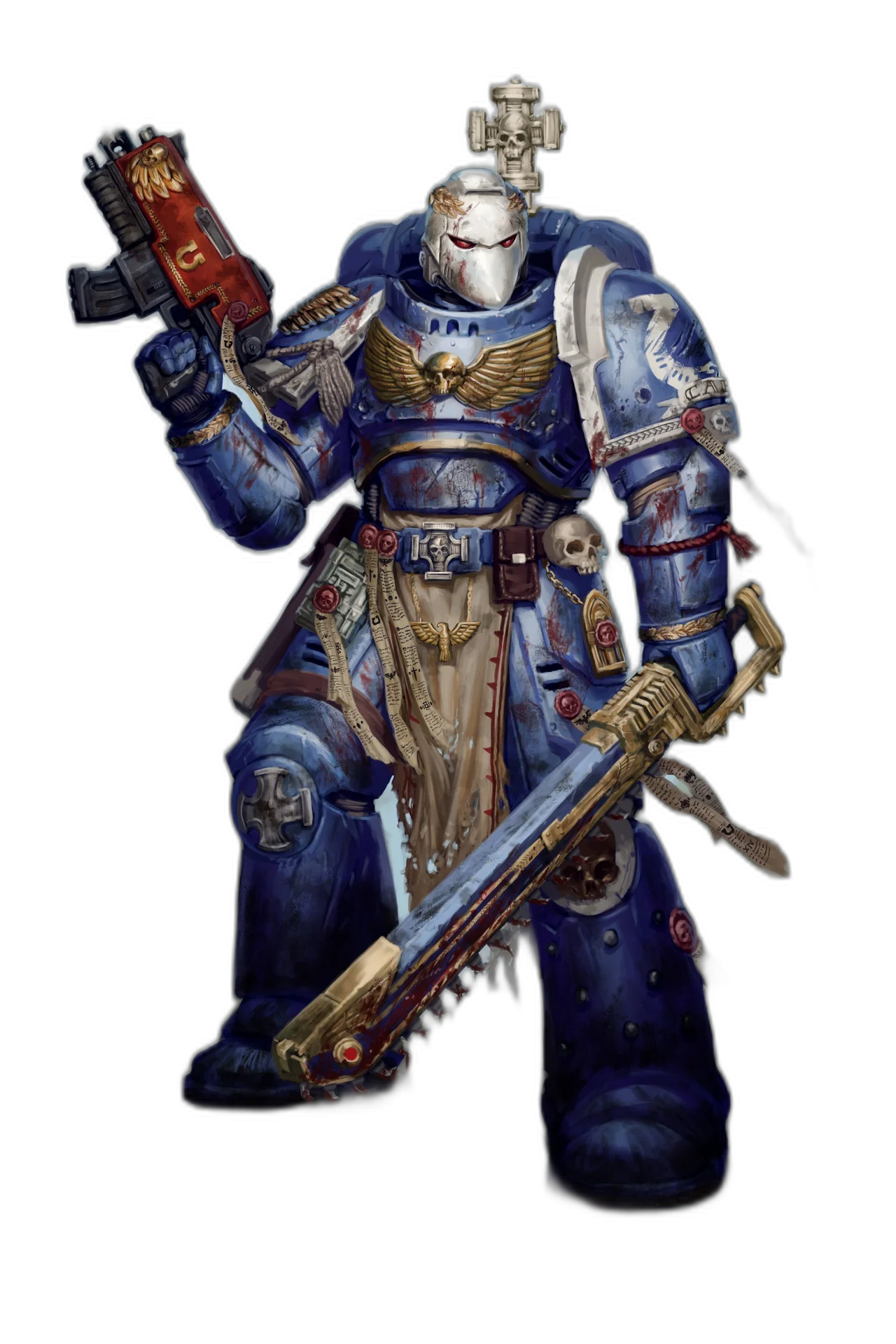
The captain who routes death by exception — vox-aerial bristling, signum lenses lit, his squad's targeting binding into a single Astartes will.
The tactical multiplier provided by a signum-equipped officer is doctrinally established across every Imperial force. A squad whose Sergeant carries a working signum concentrates fire approximately twice as effectively as a squad whose Sergeant has lost or had his signum disabled — fire-discipline, target prioritisation, and reaction time all improving substantially when the signum's cogitator can guide the officer's voice. This is not a marginal improvement but a categorical one; the Adeptus Astartes training cadres treat signum-loss in combat exercises as equivalent to losing the Sergeant himself, so severe is the doctrinal degradation. The same lesson is taught to Astra Militarum officer cadets at every Schola Progenium, in different language but with identical intent.
Master-Crafted variants exist for the most senior officers — Chapter Masters, Imperial Guard Generals, Inquisitor Lords, Ecclesiarchy Cardinals operating in active warzones. These hand-built relics are sometimes named (Ultramarines tradition holds that Marneus Calgar's signum is called the Eye of Macragge, though the canon record on this is fragmentary), and incorporate cogitator-spirit bindings of substantially higher capacity than standard issue — capable of aggregating not just a squad's auspex feed but an entire company's, with sub-cogitator systems that can compute multi-vector fire-solutions across whole battlefields. Master-Crafted signums are not produced; they are inherited, and their loss is institutional grief. A Chapter that has lost its named signum-relic considers itself diminished until a successor relic can be commissioned and consecrated.
The risk profile of the signum is correspondingly steep. A captured signum yields catastrophic intelligence to the enemy — augur-pattern data, command structure, Cipher-clearance level, the cogitator-spirit's working knowledge of the carrying officer's recent operations. Imperial doctrine therefore mandates a self-destruct protocol: if compromise is imminent and recovery infeasible, the signum is destroyed by its bearer through a small-charge that renders the cogitator-spirit's contents unrecoverable. Officers are trained to execute this protocol without hesitation. The signum's destruction is treated as a sacred duty equivalent to the destruction of any Imperial relic that cannot be denied to the enemy by any other means; the officer who fails to destroy a captured signum is judged, in Adeptus Mechanicus tribunal review, to have committed a doctrinal failure equal to surrender.
Operating a signum is a sacred technical art that the Mechanicus teaches separately from the operation of the auspex itself. Officers are not permitted to draw a signum from issue without first completing the prescribed interrogation-rite training — typically a six-month curriculum at Mechanicus-supervised facilities, covering proper cogitator-spirit address, ritual data-purification, frequency-discipline, and the litanies appropriate to each operational state of the device. A Sergeant who has not completed this training carries an auspex; a Sergeant who has completed it carries a signum, and the difference in his combat effectiveness — and his squad's casualty rate — is, by long Departmento measurement, substantial.
Vox-Caster
Encrypted vox-channels carry the regiment's voice across the battlefield, binding scattered companies to a single will.
The vox-caster is the long-range voice of the Imperial fighting formation — a shoulder-mounted, twelve-kilogram cogitator-and-antenna assembly that transmits sub-etheric communication across kilometres of battlefield, line-of-sight in atmosphere and effectively unlimited in vacuum within line-of-sight constraints. Where the micro-bead binds a squad and the signum binds an officer to his squad, the vox-caster binds whole platoons and regiments together — the Sergeant's voice carrying to the Captain, the Captain's voice carrying to the Colonel, the Colonel's orders flowing back down to every line trooper across the kilometres of frontage that an Astra Militarum regiment occupies.
The standard pattern requires a dedicated Voxman — a soldier whose primary battle-role is to carry the vox-caster, monitor its frequencies, transmit and receive on behalf of his Sergeant or officer, and protect the device with his life if necessary. Voxmen are trained at every Schola Progenium and at Astartes Chapter recruitment-equivalents in extensive Cipher discipline: the rotating frequency schedules of the Adeptus Mechanicus sanctioned protocol, the multi-key encryption layered over the frequency rotation, the proper litanies for cogitator-spirit address, and the rapid-rote phraseology of standardised tactical communication. A Voxman is not merely a man with a backpack; he is a clearance-bearing communications specialist whose competence is doctrinally critical to his unit's effectiveness.
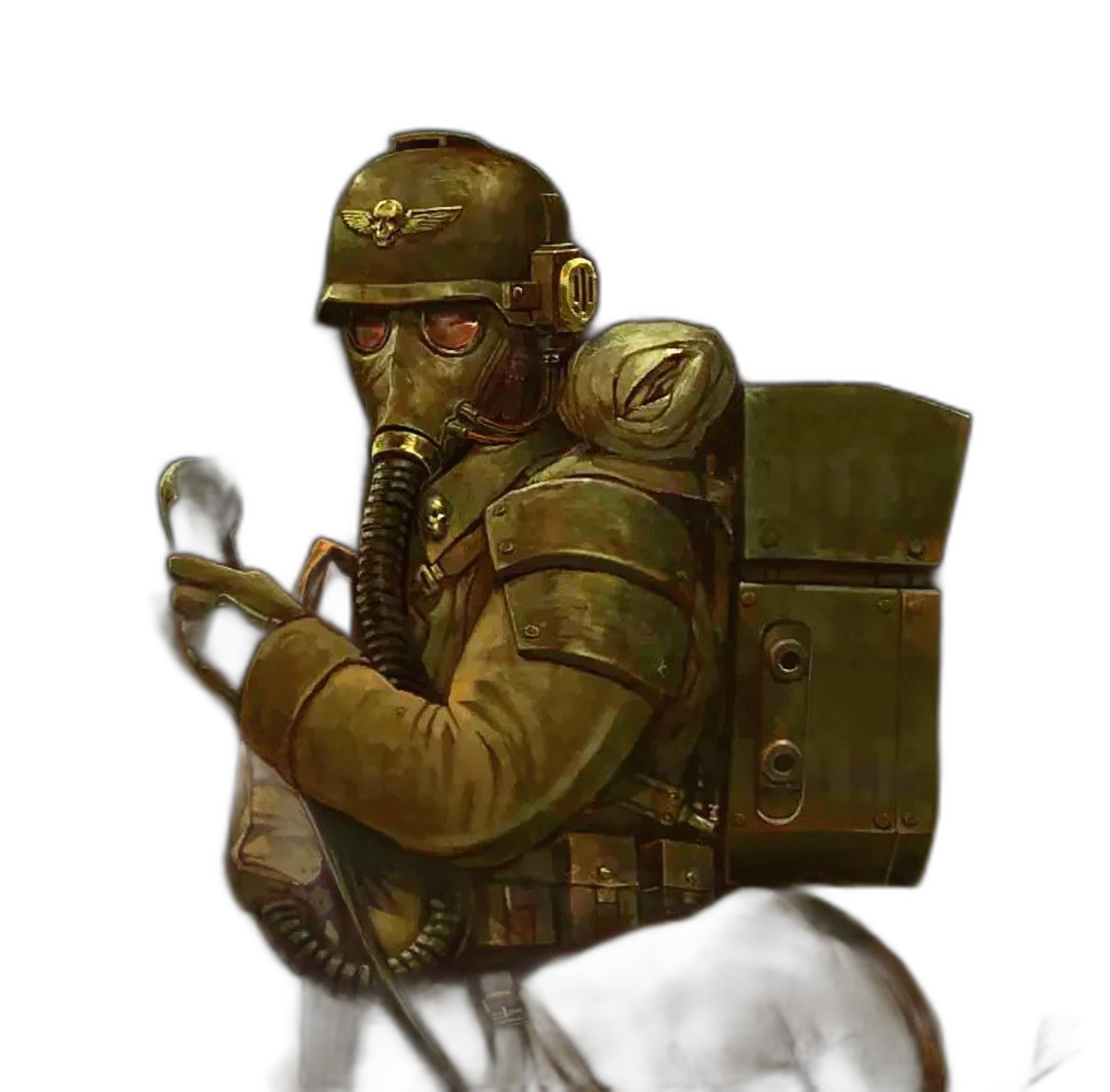
Death Korps vox-operator at the column's edge — encrypted orders carrying through artillery smoke and storm-light.
Operational range varies substantially by environment. In atmosphere on open ground, a standard Mark III vox-caster transmits effectively across approximately five kilometres line-of-sight, with longer ranges achievable through atmospheric ducting or in colder, drier conditions. In vacuum and across orbital relay, the same device can reach across an entire planetary surface or to ships in low orbit. For inter-system communication, vox-casters cannot operate independently — they must relay through Imperial astropath networks, which carry the signal across the Warp using telepathic transmission rather than sub-etheric. The vox-caster is therefore a tool of the local battlefield, not the galactic theatre, but within its own scale it is the indispensable instrument of formation-coordination.
The Voxman is, by long-established enemy doctrine across multiple xenos and traitor adversaries, a priority target. Sniper units in Chaos, Eldar Pathfinder formations, and Tau Pathfinder teams all train explicitly to identify and eliminate vox-bearers before engaging the broader Imperial line — the calculation being that a regiment without vox is a regiment whose officers cannot coordinate, whose squads cannot be supplied with timely intelligence, and whose line will degrade within minutes of contact. Imperial standing orders therefore mandate backup vox capacity per platoon — a second Voxman, a vox-rated officer's signum, or a redundant command-channel — so that the loss of any single Voxman does not collapse the formation's coordination.
Mechanicus rites for the vox-caster are extensive and exacting. Each device is fed sacred unguents at the conclusion of every operational tour; its frequency crystals are replaced — not cleaned, replaced — at intervals dictated by the local enginseer's interpretation of the cogitator-spirit's running condition. The antenna assembly is Mechanicus-blessed at activation and again before each major engagement; the sub-etheric transmitter coils receive specific litanies of resonance that the Voxman is taught to recite in private before deployment. A vox-caster that has not received its full Mechanicus benediction within the prescribed interval is considered, by both Mechanicus and command doctrine, to be in a state of impaired sanctity, and its use in active combat is prohibited until the rites are completed.
Specialist variants exist at the margins of standard issue. Vox-relay drones — a Heresy-era technology, increasingly rare in the M41 — can be deployed forward of an Imperial line to extend vox-range without exposing a Voxman to enemy fire; these are produced only on a small handful of forge-worlds and are largely the province of Adeptus Astartes strike-cruiser detachments and Inquisitorial operations. Long-range vox-relay arrays, planetary in scale, exist on most Imperial-occupied worlds and are independent of the personal vox-caster equipment described here. The standard vox-caster as carried by the Astra Militarum Voxman is, however, the universal pattern — the device that, more than any other, ties the dispersed mass of Imperial formations into a coherent fighting force.
Micro-Bead
The micro-bead is the smallest and most personal piece of communications equipment in the Imperial arsenal — a sub-centimetre cogitator-and-transceiver assembly implanted directly into the wearer's ear canal during initiation, providing silent, hands-free vox-traffic across approximately one kilometre of intra-squad range. For the Adeptus Astartes battle-brother, the micro-bead is implanted alongside the other surgical augmentations of his Astartes induction; for senior Astra Militarum officers and Inquisitorial Acolytes, it is fitted at commission. Once implanted, the micro-bead becomes effectively part of the wearer's body, drawing power from a sub-cutaneous cell that is recharged through the wearer's own armour systems or through periodic Mechanicus-supervised maintenance.
A bead in the ear — the smallest sacrament of the Imperial vox, binding flesh to the regiment's voice across the noise of battle.
The tactical role of the micro-bead is silent intra-squad communication during operations where vocal speech would compromise the unit. Stealth ingress, urban room-clearing, void boarding-action through pressurised compartments, hostage-recovery operations conducted by Inquisitorial strike teams — every situation in which a soldier must communicate with his squadmates without alerting the enemy by audible voice — these are the situations the micro-bead exists to serve. The hand-signals taught at every Imperial training facility are augmented and often superseded by micro-bead traffic, with sergeants able to issue directional orders in whispered tones below the threshold of enemy auditory detection.
Range is the micro-bead's principal limit. One kilometre is sufficient for a squad operating in close formation; it is insufficient for any larger formation, and in conditions of local jamming — corridor signal-loss, Chaos-induced electromagnetic noise, deliberate enemy ECM — the practical range can collapse to mere metres. The micro-bead is therefore not a substitute for the vox-caster but its complement — micro-bead for intra-squad, vox-caster for the squad-to-platoon-and-above link. A squad operating beyond micro-bead range of its parent platoon relies on the vox-caster Voxman to bridge the gap; a squad that has lost its Voxman and operates on micro-bead alone is a squad in serious trouble.
Cipher discipline on the micro-bead is simpler than on the vox-caster but no less rigorous. Each squad operates on a squad-cipher that is rotated weekly under standing Departmento procedure, with the Sergeant holding the cipher-key and verifying that all his men's micro-beads are properly synchronised before deployment. Captured micro-beads cannot easily be exploited by the enemy — the ear-canal implantation makes recovery from a fallen soldier difficult and damaging — but the cipher discipline assumes worst-case nonetheless. A micro-bead that has not been re-keyed within the prescribed interval is considered insecure and is not used until the next cipher-rotation can be applied.
Specialist variants serve secret-society applications across the Imperium's clandestine institutions. The Inquisition's Acolyte cells use micro-beads with one-time-pad cipher protocols rather than rotating cipher schedules — every transmission encrypted to a key that exists nowhere except in the cogitator-spirits of the participating beads at the moment of transmission. The Officio Assassinorum maintains its own pattern, smaller still and harder to detect under augur-sweep, used by Vindicare and Eversor operatives during deep-penetration operations. These specialist patterns are not produced through standard Mechanicus channels but through Mechanicus-sanctioned subsidiary forges that operate under direct Inquisitorial or Officio supervision; their existence is acknowledged in standard doctrinal texts but their detailed specifications are not.
Cogitator-Array
The battle-cogitator binds the augur-pulse into a single litany of contacts — Mars-pattern logic engines parsing sensor returns into command-grade certainty.
The cogitator-array is the largest sensor-cogitator system that the Imperium routinely fields in active warfare — a vehicle-mounted or installation-mounted augur cluster orders of magnitude more capable than any handheld auspex, dedicated to resolving the complex augur-environment of an entire battlefield. Where the auspex sweeps forty metres of corridor and the signum aggregates a squad's returns, the cogitator-array sweeps two to ten kilometres of tactical theatre, computing fire-solutions, identifying enemy formations, distinguishing genuine signatures from decoys, and feeding processed intelligence down to the signums of the officers who command the soldiers within its operational range.
A magos hunches over a battle-cogitator, skitarii silent at his flank — Mechanicus communion with the Omnissiah, byte by sacred byte, while war burns the horizon.
Standard cogitator-array installations are mounted on Imperial battle-tanks of all classes — Land Raiders, Predator command variants, Leman Russ command pattern, Stormblade super-heavies, Imperial Knight thrones, and the larger Mechanicus walker patterns. Each vehicle-borne cogitator-array is integrated with its host's machine-spirit and operates as the host's tactical sensoria-aggregator, drawing data from the vehicle's own sensors and from the auspex-feeds of nearby allied formations. Crew operation requires either a tech-priest enginseer or a dedicated cogitator-operator who has completed specialised Mechanicus training — the cogitator-array's machine-spirit is too sophisticated, too theologically loaded, to be operated competently by a generalist soldier without specific instruction.
Installation-grade cogitator-arrays serve fortress-class facilities across the Imperium — fortress-monasteries of Adeptus Astartes Chapters, Adeptus Mechanicus forge-cathedrals, Departmento Munitorum command-bunkers, Astra Militarum regimental headquarters in protracted campaigns. These installations operate at substantially greater scale than any vehicle-mounted system, with operational ranges extending beyond fifty kilometres in some cases and sub-cogitator clusters dedicated to specific analytical tasks — fire-coordination, enemy-formation analysis, supply-route monitoring, even strategic threat-pattern recognition that crosses temporal scales. The Cawl-pattern cogitator installations now reaching some Imperial command facilities incorporate sub-systems with limited self-improvement capacity, an innovation that some elements of the Adeptus Mechanicus consider theologically suspect even as the Imperial command structure embraces their tactical advantages.
A specialist deployment of cogitator-array technology is the scry-skull — a recon-dedicated servo-skull pattern functioning as a forward-deployed extension of a parent cogitator-array. Rather than a generalised servo-skull (which performs broader tactical functions and is treated in the tactical-wargear arsenal page), the scry-skull carries an integrated augur-cluster and feeds its returns back to the cogitator-array of its operating unit. Scry-skulls are issued primarily to Adeptus Astartes reconnaissance formations, to Skitarii Vanguard maniples, and to Inquisitorial deep-penetration cells. They extend the operational reach of their parent cogitator-array into terrain that no vehicle could traverse and that no human soldier could approach without unacceptable risk.
Crew responsibility for cogitator-arrays is among the most theologically loaded duties in the Imperial military hierarchy. Tech-priest enginseers assigned to cogitator-array operation undergo years of preparatory training before being permitted to interrogate the array's machine-spirit; the proper litanies must be recited in the proper sequence; the data-purification rites must be performed at prescribed intervals; the sub-cogitator clusters must be addressed by their proper names and offered the prescribed unguents at activation. A cogitator-array operated outside these constraints is considered, by Mechanicus doctrine, to be operating in a state of impaired sanctity, with corresponding degradation of its operational reliability — and that degradation, in the Mechanicus theological framework, is real and measurable, not merely ritual or symbolic.
Doctrine, Cipher, and Reverence
Cipher discipline structures every aspect of Imperial sensor and communications use. The Imperial Cipher exists in graduated clearance levels — alpha, beta, gamma, and the deeper inquisitorial-grade levels accessible only to Inquisitor Lords and above — with each level rotating its keys at intervals dictated by operational tempo. In active warzones the rotation can be hourly; in peacetime garrison the rotation is weekly. Misuse of cipher protocols — transmitting clear-text where encrypted-text is required, breaking cipher discipline by indicating clearance level to unauthorised personnel, or using the wrong cipher-tier for the message-sensitivity — is doctrinally classified as heresy of the lesser sort, punishable by Adeptus Mechanicus tribunal review and, in serious cases, by Commissar summary action. The cipher is sacred; its violation is not merely error but theological breach.
Beneath cogitator-scripture and chained censers, the magos channels the litany that turns signum into sacrament — every reading anointed, every transmission a prayer.
Counter-augur tactics employed by the Imperium's enemies shape much of the practical doctrine. The Tyranid genestealer's biological capacity for bio-signature suppression is well-documented and trained against in every Adeptus Astartes Scout cadre's curriculum; the Eldar dimensional shroud, which masks Aspect Warrior formations from auspex-detection, has been the subject of Mechanicus counter-research for millennia and continues to defeat Imperial augur on most occasions; the Necron canopt-screen interferes with cogitator-spirits at frequencies that the Mechanicus has never fully understood. Loyal soldiers are trained to layer auspex-augur with optical confirmation, to assume that any apparently empty space might harbour something the augur cannot detect, and to trust the eye when the augur returns silence. The augur is sacred but it is not omniscient.
Battle-drills for sensor- and communications-loss are codified across every Imperial fighting formation. When vox is lost — Voxman fallen, antenna severed, frequencies jammed — the standing order is "follow-the-line": every soldier maintains contact with the soldier to his left and right, and through that physical chain the formation's coherence is preserved while alternate communications are restored. When signum is lost — the officer killed, his device captured — the senior NCO assumes command and resumes signum-equivalent function with whatever combination of voice, hand-signal, and squad-level micro-bead is available. These drills are practised at every Schola Progenium and at every Astartes Chapter's recruit-training cadre until they are automatic; in the moment of loss, no soldier asks what to do, because the answer is already in his muscle memory.
Joint-operations protocols for sensor and communications equipment matter wherever Astartes and Astra Militarum formations operate together. The signum-to-signum handshake — the technical procedure by which an Astartes Sergeant's signum and a Astra Militarum Lieutenant's signum mutually authenticate and establish shared cipher-state — is taught at staff-college level and is one of the more theologically dense practices in the Imperial military doctrinal corpus. When the handshake completes successfully, the two signums function as a unified command-cogitator pair across the joint formation; when it fails, the two formations operate as separate units even when nominally co-located, with all the coordination loss that implies. Mechanicus enginseers attached to either formation can sometimes coax a failed handshake to completion through specific litanies of cogitator-spirit reconciliation, but the procedure is delicate and not always successful.
Beyond the tactical, the Imperium's astropath corps integrates sensor-and-communications doctrine into the strategic frame. Astropathic vox-relay carries inter-system orders across the Warp, with the Astronomican beacon serving as the ultimate frequency-of-frequencies — the singular psychic signal by which all loyal Imperial astropaths orient themselves and their sub-channels. This is not technology in the strict sense; it is psychic capacity bound into a ten-thousand-year ritual practice, the Emperor of Mankind's own sustained mental effort underlying every long-range Imperial communication. To grasp the full scope of Imperial sensor and communications doctrine is therefore to grasp that, at its highest tier, the system is not merely cogitator-and-vox but psyker-and-Emperor — a chain that begins at the soldier's micro-bead and ends, after every relay and intermediation, at the Throne itself.